
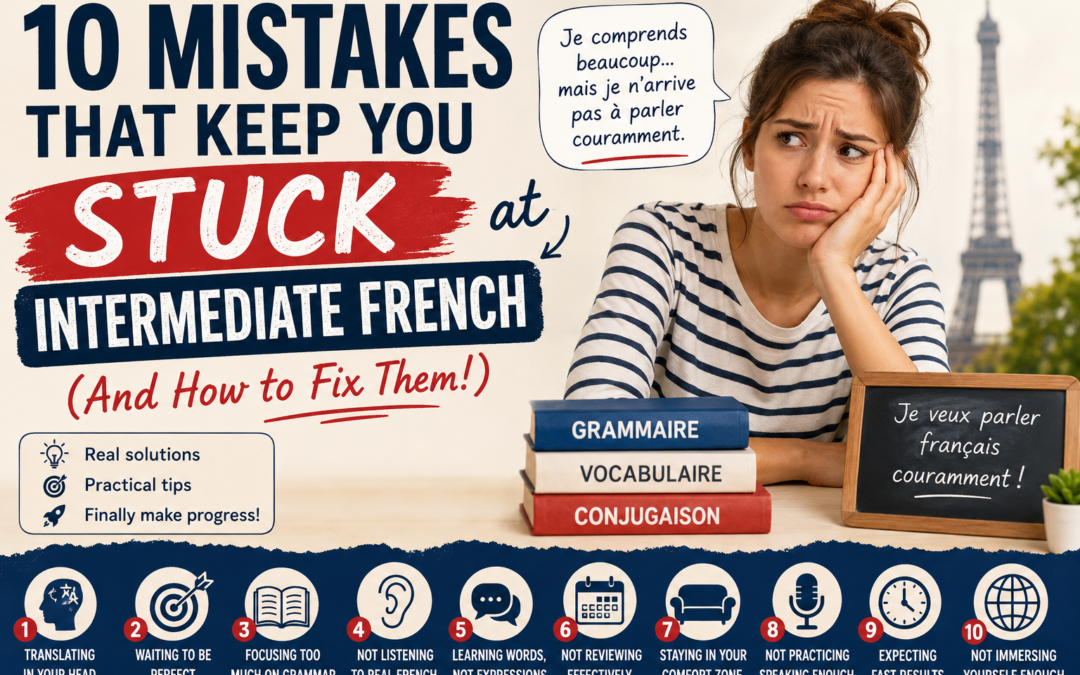
You’ve been learning French for a while now.
You understand a lot. You can follow conversations… sometimes. You can speak… but not as well as you’d like.
And yet, something feels stuck.
You’re not a beginner anymore — but you’re not fluent either.
This is what we call the intermediate plateau.
And here’s the truth:
It’s not about talent. It’s not about time.
It’s about mistakes in your learning approach.
Let’s break the 10 most common mistakes that keep learners stuck — and how to finally move forward.
Mistake #1: Translating Everything in Your Head
The problem: You hear: “Je vais le faire”
And your brain goes:
→ “I go to do it… okay that means I’m going to do it.”
Too slow. Too heavy.
Why it blocks you:
Translation creates a delay between understanding and speaking.
The fix:
Start thinking in chunks.
Instead of translating, learn: Je vais le faire = I’ll do it
Astuce :
“Penser en français” = penser directement sans traduire.

Mistake #2: Waiting to Speak Perfectly
The problem: you wait until you “feel ready.”
You correct yourself constantly.
Reality check:
Fluency is messy.
Even natives hesitate, repeat, simplify.
The fix:
- Speak with imperfection.
- Use simple sentences:
- Je pense que… (I think that…)
- C’est difficile à expliquer… (It’s hard to explain…)
Important : “Mieux vaut parler mal que ne pas parler du tout.”
(Better to speak badly than not at all.)
Mistake #3: Focusing Too Much on Grammar Rules
The problem: you know: subjonctif, conditionnel , agreements…
But you hesitate when speaking.
Why:
Grammar ≠ fluency.
The fix:
- Shift from knowing → using
- Instead of:
- studying rules
Do:
sentence repetition
real-life examples
Exemple :
Instead of learning rules for subjonctif:
Learn: Il faut que je fasse ça
Mistake #4: Not Understanding Real Spoken French

The problem: yYou understand textbooks… but not real people.
Why:
Real French =
- fast
- reduced
- connected
Example:
Je ne sais pas → “chais pas”
The fix:
- Listen to:
- podcasts
- YouTube
- real conversations
Astuce :
Habitue ton oreille au “français réel”, pas seulement au français scolaire. Accustom your ear to “real French”—not just textbook French.
Mistake #5: Learning Words Instead of Expressions
The problem: you know the word “prendre”…
But not:
prendre une décision
prendre le temps
Why:
Vocabulary = combinations, not isolated words.
The fix:
- Learn chunks:
- avoir envie de
- être en train de
Clé :
“Apprendre des expressions, pas des mots.” Learn expressions, not words.
Mistake #6: Not Reviewing Effectively

The problem: you learn a lot… and forget everything.
Why:
No repetition = no memory.
The fix:
- Use spaced repetition:
- review after 1 day
- 3 days
- 7 days
Important :
“Répéter = progresser.”Repetition equals progress.
Mistake #7: Staying in Your Comfort Zone
The problem: you only use what you already know.
Why:
No challenge = no growth.
The fix:
- Push yourself:
- try longer sentences
- use new structures
Exemple :
Instead of:
C’est bien. It’s good
Try:
C’est vraiment intéressant parce que…That’s really interesting because…
Mistake #8: Not Practicing Speaking Enough
The problem: you study… but don’t speak.
Reality:
Speaking is a skill.
You can’t improve without practice.
The fix:
- Speak every day:
- alone
- with a partner
- recording yourself
Astuce :
Parle même tout seul. Ça fonctionne. Even talk to yourself. It works.
Mistake #9: Expecting Fast Results
The problem: You feel stuck → you lose motivation.
Truth:
Progress slows down at intermediate level.
But it’s still happening.
The fix:
- Track small wins:
- better understanding
- smoother sentences
Rappel : “Le progrès est lent, mais réel.” Reminder : Progress is slow, but real.
Mistake #10: Not Immersing Yourself Enough
The problem: French is just a “study subject.”
The fix:
- Make French part of your life:
- phone in French
- series in French
- podcast in french
- thinking in French
Objectif :
Vivre en français, pas seulement l’apprendre.To live in French—not just learn it.
Conclusion
If you’re stuck at intermediate level, it’s not because you’re bad at languages.
It’s because your method needs to evolve.
Stop:
- translating
- waiting
- overthinking
Start:
- speaking
- listening
- using real French
- Final thought
Fluency doesn’t come from knowing more.
It comes from using what you already know — better.
Dernière phrase :
“La fluidité ne vient pas de ce que tu apprends, mais de ce que tu utilises.” Fluency comes not from what you learn, but from what you use.
Want to go further?
Try this simple challenge:
For the next 7 days:
- speak French every day
- think in French
- learn 5 expressions (not words)
If you do this seriously…
you won’t be stuck anymore
Want to SPEAK French with confidence?
I offer guided speaking lessons with:
– real conversations
– useful vocabulary
– cultural topics
Apply here (limited spots):
https://calendly.com/julie-frenchclassteacher-us/30-minutes-meeting