
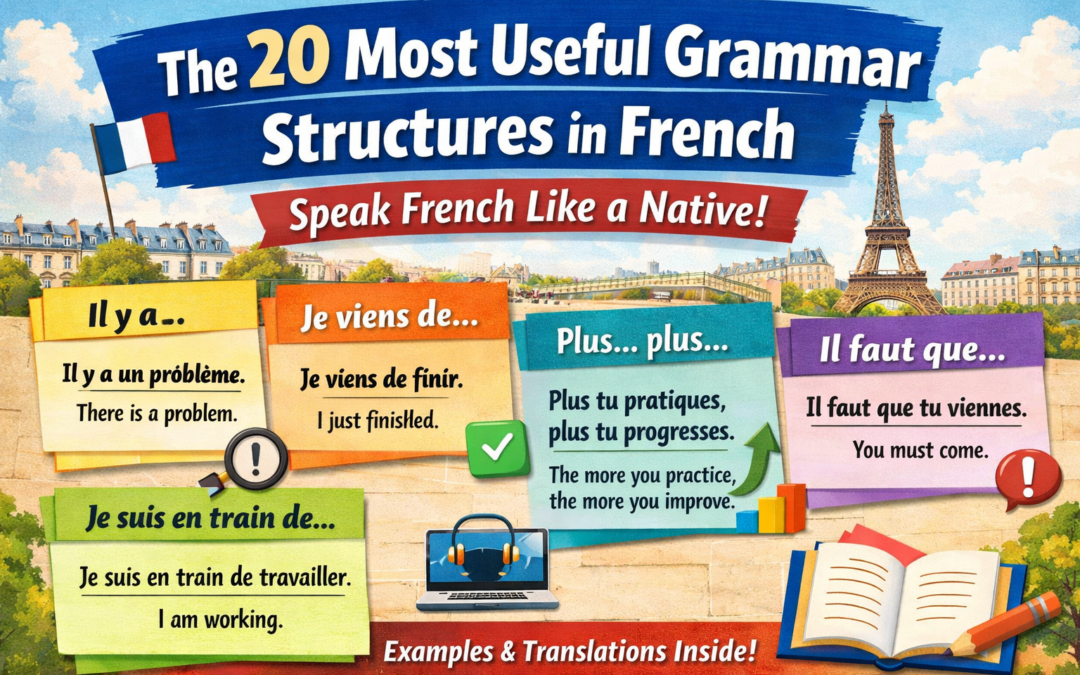
When you learn French, vocabulary is important—but grammar structures are what truly make you sound natural.
Many learners know individual words but struggle to build correct and fluid sentences. The key is not to memorize random words, but to learn ready-to-use structures that French people use every day.
In this guide, you will discover 20 essential French grammar structures, with:
- clear explanations
- example sentences in French
- English translations for every example
These structures will help you:
- speak more fluently
- understand native speakers
- sound more natural
Let’s start with the most essential ones.
1. Il y a (There is / There are)
This structure is used to talk about existence.
Example:
Il y a un problème.
There is a problem.
Example:
Il y a beaucoup de monde.
There are many people.
2. C’est / Ce sont (It is / They are)
Used to identify or describe something.
Example:
C’est facile.
It is easy.
Example:
Ce sont mes amis.
They are my friends.
3. Il faut + infinitive (You must / It is necessary)
Used to express a general obligation.
Example:
Il faut étudier.
You must study.
4. Il faut que + subjunctive
Used when there is a second subject.
Example:
Il faut que tu viennes.
You must come.
5. Avoir besoin de (To need)
Example:
J’ai besoin d’aide.
I need help.
6. Avoir envie de (To feel like / want)
Example:
J’ai envie de partir.
I feel like leaving.
7. Être en train de (To be doing something)
Used to emphasize an action in progress.
Example:
Je suis en train de travailler.
I am working.
8. Venir de (Recent past)
Used for something that just happened.
Example:
Je viens de finir.
I just finished.
9. Aller + infinitive (Near future)
Used to talk about something that will happen soon.
Example:
Je vais partir.
I am going to leave.
10. Depuis (Since / For)
Used for actions that started in the past and continue now.
Example:
J’habite ici depuis deux ans.
I have lived here for two years.
11. Ça fait… que (Duration)
Another way to express duration.
Example:
Ça fait deux ans que j’habite ici.
I have lived here for two years.
12. Il y a… que (Duration – less common)
Example:
Il y a deux ans que j’habite ici.
I have lived here for two years.
13. Plus… plus… (The more… the more…)
Used to express progression.
Example:
Plus tu pratiques, plus tu progresses.
The more you practice, the more you improve.
14. Si + présent (If + present)
Used for real situations.
Example:
Si tu viens, je suis content.
If you come, I am happy.
15. Si + imparfait (Hypothesis)
Used for hypothetical situations.
Example:
Si j’avais le temps, je voyagerais.
If I had time, I would travel.
16. Il semble que + subjunctive
Used to express uncertainty.
Example:
Il semble qu’il soit fatigué.
It seems that he is tired.
17. Bien que + subjunctive (Although)
Used to express contrast.
Example:
Bien qu’il soit tard, je travaille.
Although it is late, I work.
18. Pour que + subjunctive (So that)
Used to express purpose.
Example:
Je parle lentement pour que tu comprennes.
I speak slowly so that you understand.
19. Avant de / Avant que (Before)
Used to express an action happening before another.
Example:
Je mange avant de partir.
I eat before leaving.
Example:
Pars avant qu’il arrive.
Leave before he arrives.

20. En + participe présent (While / by)
Used to express simultaneous actions.
Example:
Il apprend en travaillant.
He learns by working.
Now that you have learned these 20 essential structures, the next step is to practice them actively.
Practice is what transforms knowledge into real speaking ability.
Let’s move on to some exercises.
Exercises
Exercise 1 – Translate into French
- I need help.
- I am working.
- I just finished.
- The more you study, the more you improve.
- I am going to leave.
Exercise 2 – Complete the sentence
- Il faut que tu ______ (venir).
- Je suis en train de ______ (travailler).
- Je viens de ______ (finir).
- Si j’avais le temps, je ______ (voyager).
- Je parle lentement pour que tu ______ (comprendre).
Exercise 3 – Translate into English
- Je vais partir.
- Il y a un problème.
- Je suis en train de manger.
- Bien qu’il soit fatigué, il travaille.
- Ça fait deux ans que j’habite ici.
Corrections
Exercise 1
- J’ai besoin d’aide.
I need help. - Je suis en train de travailler.
I am working. - Je viens de finir.
I just finished. - Plus tu étudies, plus tu progresses.
The more you study, the more you improve. - Je vais partir.
I am going to leave.
Exercise 2
- viennes
- travailler
- finir
- voyagerais
- comprennes
Exercise 3
- Je vais partir.
I am going to leave. - Il y a un problème.
There is a problem. - Je suis en train de manger.
I am eating. - Bien qu’il soit fatigué, il travaille.
Although he is tired, he works. - Ça fait deux ans que j’habite ici.
I have lived here for two years.
Conclusion
Learning French grammar becomes much easier when you focus on useful structures instead of isolated rules.
These 20 structures will help you:
- speak more naturally
- build correct sentences
- understand native speakers
The key is simple:
Practice a few structures every day
Use them in real conversations
With time, they will become automatic and your French will sound more fluent and more natural.
A bientôt
Julie