
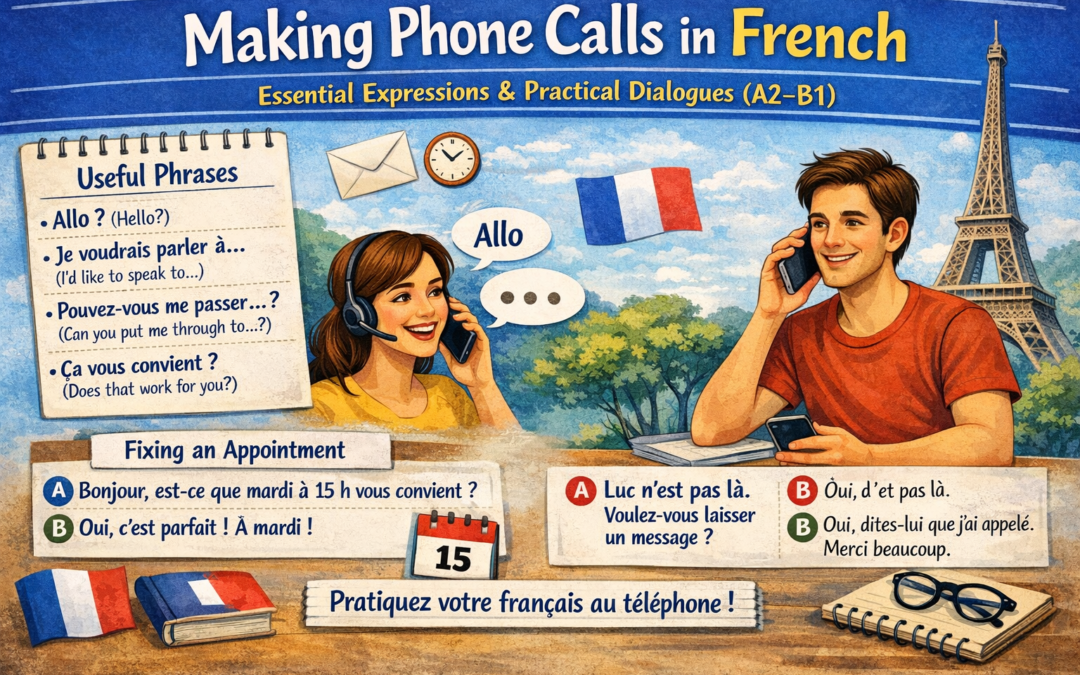
Making phone calls in French can be stressful for many learners: you can’t see the other person, the speech is often fast, and many expressions are very fixed.
In this article, you’ll learn essential French phone expressions, organised by real-life situations, with model dialogues and practice exercises.

Starting a Phone Call (Getting Through)
When calling a company or an institution, French uses polite and formal expressions.
Key expressions
| Receptionnist expressions | Caller expressions |
| Société Bharat, bonjour. (Bharat Company, hello.) |
Bonjour, madame / monsieur. (Hello, madam / sir.) |
| Je voudrais parler à Monsieur Val, s’il vous plaît. (I would like to speak to Mr Val, please.) |
|
| C’est de la part de qui ? (Who is calling, please? / Who is it from?) |
De la part de Rajesh Kumar. (From Rajesh Kumar.) |
| C’est à quel sujet ? (What is it about?)
|
Je voudrais une information concernant la réunion de demain. (I would like some information about tomorrow’s meeting.)
|
| Un instant, je vous le passe. (One moment, I’ll put you through.) |
Merci (Thank you) |
Here the complete dialogue Model for a phone call
— Société Bharat, bonjour.
(Bharat Company, hello.)
— Bonjour madame. Je voudrais parler à Monsieur Val, s’il vous plaît.
(Hello madam. I’d like to speak to Mr Val, please.)
— C’est de la part de qui ?
(Who is calling?)
— De la part de Rajesh Kumar.
(From Maud Vidal.)
— C’est à quel sujet ?
(What is it about?)
— Je voudrais une information concernant la réunion de demain.
(I’d like some information about tomorrow’s meeting.)
— Un instant, je vous le passe.
(One moment, I’ll put you through.)
Language tip
Je voudrais (I would like) is much more polite than je veux (I want) when speaking on the phone.
Once the call has started, you may not always reach the person you are looking for. In many professional situations, the person is unavailable, which requires using specific expressions to continue the conversation politely.
The Person Is Absent or Unavailable
This is a very common situation in professional contexts.
| Receptionnist expressions possible | Caller expressions |
| Je regrette, Monsieur Val est absent / en réunion / en déplacement. (I’m sorry, Mr Val is absent / in a meeting / away on business.) |
Savez-vous quand je peux le joindre ? (Do you know when I can reach him?)
|
| Son poste ne répond pas / est occupé. (His extension is not answering / is busy.) |
Je rappellerai plus tard. (I’ll call back later.) |
| Voulez-vous patienter ? (Would you like to hold?) |
Oui Merci (Yes thank you) |
| Pouvez-vous rappeler plus tard ? (Could you call back later?) |
Oui bien sûr, merci (Yes sure, thanks) |
| Or
Est-ce que je peux laisser un message ? |
|
| Oui, quel est votre message ? (Yes, what is your message?) | Pouvez-vous lui demander de me rappeler ? (Can you ask him to call me back?) |
| Voulez-vous laisser un message ? (Would you like to leave a message?) |
Pouvez-vous lui dire que Rajesh Kumar a appelé ? (Can you tell him that Rajesh Kumar called?) |
Here the complete dialogue Model
— Je regrette, Monsieur Val est en réunion.
(I’m sorry, Mr Val is in a meeting.)
— Savez-vous quand je peux le joindre ?
(Do you know when I can reach him?)
— Cet après-midi, vers 15 heures.
(This afternoon, around 3 p.m.)
— Très bien, je rappellerai plus tard.
(Alright, I’ll call back later.)

When the person you are calling cannot take the call, the next step is often to leave a message. Knowing how to do this clearly and politely is essential in your French professional communication.
Leaving a Message during a phone call
Useful expressions
- Est-ce qu’il a votre numéro ?
(Does he have your number?) - Voici mon numéro : 06…
(Here is my number: 06…) - Entendu, c’est noté.
(Got it, I’ve noted it down.) - Je lui transmets le message.
(I’ll pass on the message.)
Vocabulary note:
Entendu is very common in professional French and means “understood” or “got it”.
Not all phone calls go as planned. Sometimes, despite our best intentions, we realise that we have dialled the wrong number. In this case, French uses very specific and polite expressions.
Wrong Number
Key expressions
- Monsieur Val?
(Mr Val?) - Vous vous êtes trompé(e) de numéro.
(You have dialed the wrong number.) - Vous n’êtes pas Monsieur Val ?
(Aren’t you Mr Val?) - Non, vous êtes à la pharmacie.
(No, this is a pharmacy.) - J’ai fait le mauvais numéro, excusez-moi.
(I dialled the wrong number, sorry.) - Ce n’est pas grave / C’est pas grave.
(That’s alright / No problem.) - Je vous en prie. Au revoir.
(You’re welcome. Goodbye.)
Even when you have the right number, technical problems can still interrupt a conversation. Understanding how to explain these issues in French helps avoid confusion and frustration.
Technical Problems on the Phone
Essential expressions
- Allô ? Allô ? J’ai du mal à vous entendre.
(Hello? Hello? I can’t hear you very well.) - La ligne est mauvaise.
(The line is bad.) - On a été coupés.
(We got cut off.) - Je ne sais pas ce qui s’est passé.
(I don’t know what happened.) - J’ai raccroché par erreur.
(I hung up by mistake.) - J’ai appuyé sur la mauvaise touche.
(I pressed the wrong button.)
Cultural tip
In spoken French, people usually say “On a été coupés” rather than a more formal expression.
Mini Exercises: Making phone calls in French
Exercise 1 – Complete the Dialogue (Contextualised)
Situation:
Maud Vidal calls a company to speak to Mr Bic about a meeting.
Instructions
Complete the dialogue using the expressions below.
Expressions to use:
de la part de – un instant – je voudrais – en réunion – rappeler plus tard – à quel sujet
Dialogue
— Société Bharat, bonjour.
— Bonjour madame. __________ parler à Monsieur Val, s’il vous plaît.
— C’est __________ qui ?
— __________ Rajesh Kumar.
— C’est __________ ?
— Je voudrais une information concernant la réunion de demain.
— Je regrette, Monsieur Val est __________.
— Dans ce cas, je vais __________.
— Très bien. __________, s’il vous plaît.
Dialogue corrigé
— Société Bharat, bonjour.
— Bonjour madame. Je voudrais parler à Monsieur Val, s’il vous plaît.
— C’est de la part de qui ?
— De la part de Rajesh Kumar.
— C’est à quel sujet ?
— Je voudrais une information concernant la réunion de demain.
— Je regrette, Monsieur Val est en réunion.
— Dans ce cas, je vais rappeler plus tard.
— Très bien. Un instant, s’il vous plaît.
Exercise 2 – Match the Sentences (French ↔ English)
Instructions
Match each French sentence with its correct English meaning.
| French | English |
| 1. Je vous le passe. | a. The line is bad. |
| 2. Voulez-vous laisser un message ? | b. I’ll put you through. |
| 3. Vous vous êtes trompé de numéro. | c. Would you like to leave a message? |
| 4. La ligne est mauvaise. | d. You have the wrong number. |
| 5. On a été coupés. | e. We got cut off. |
| French | Correct answer |
| 1. Je vous le passe. | b. I’ll put you through. |
| 2. Voulez-vous laisser un message ? | c. Would you like to leave a message? |
| 3. Vous vous êtes trompé de numéro. | d. You have the wrong number. |
| 4. La ligne est mauvaise. | a. The line is bad. |
| 5. On a été coupés. | e. We got cut off. |
Exercise 3 – Choose the Correct Option
Instructions
Choose the most appropriate answer for a professional phone call.
1.
— Bonjour, je ______ parler à Monsieur Bic.
a) veux
b) voudrais
c) vais
2.
— Monsieur Bic est absent.
— ______ rappeler plus tard ?
a) Voulez-vous
b) Voulez
c) Voulais
3.
— J’ai ______ le mauvais numéro.
a) fait
b) pris
c) mis
4.
— J’ai appuyé sur la ______ touche.
a) faux
b) mauvaise
c) mal
Answers:
- b) voudrais
- a) Voulez-vous
- a) fait
- b) mauvaise
Exercise 4 – Reorder the Dialogue
Instructions
Put the following sentences in the correct order.
⬜ De la part de Rajesh Kumar.
⬜ Société Bharat, bonjour.
⬜ Un instant, je vous le passe.
⬜ Je voudrais parler à Monsieur Val, s’il vous plaît.
⬜ C’est de la part de qui ?
Correct order
1 Société KM3, bonjour.
2 Je voudrais parler à Monsieur Bic, s’il vous plaît.
3 C’est de la part de qui ?
4 De la part de Maud Vidal.
5 Un instant, je vous le passe.
Exercise 5 – Writing Task (Guided Production)
Instructions
Write a short phone conversation (8–10 lines).
Situation:
You call a company to speak to a colleague, but the person is unavailable.
You:
- ask to speak to the person politely,
- learn that they are in a meeting,
- leave a message,
- ask them to call you back.
Use at least 5 expressions from the article.
Correction and possible version
— Société Bharat, bonjour.
— Bonjour, je voudrais parler à Monsieur Val, s’il vous plaît.
— Je regrette, il est en réunion.
— Est-ce que je peux laisser un message ?
— Bien sûr.
— Pouvez-vous lui dire que Rajesh Kumar a appelé ?
— D’accord. Est-ce qu’il a votre numéro ?
— Non, voici mon numéro : 06…
— Très bien, je lui transmets le message.
— Merci beaucoup, au revoir.
Exercise 6 – Real-Life Situations (Open Answers)
Instructions
What would you say in the following situations?
- You can’t hear the other person very well.
- The call suddenly stops.
- You realise you have the wrong number.
- You want to ask someone to hold.
- You want to politely end the call.
(Write one full sentence for each situation.)
Possible answer
- J’ai du mal à vous entendre.
- On a été coupés.
- Excusez-moi, je me suis trompé(e) de numéro.
- Voulez-vous patienter, s’il vous plaît ?
- Merci beaucoup. Bonne journée, au revoir.
Conclusion
Knowing how to make phone calls in French is an essential skill, especially in professional situations. By mastering these key expressions, learners gain confidence, fluency, and credibility when speaking.
The best way to improve is to practice with dialogues, repeat out loud, and simulate real phone calls. One podcast is also available here on the same topic
Julie