

Hello, dear students!
Today we have a short vocabulary lesson on the body and health. Yes, even if you make grammatical mistakes but have a large vocabulary, you can easily make yourself understood!
This vocabulary lesson is about health and the body. It’s so useful when you have to go to the doctor and explain where it hurts.

Vocabulary related to the body and health in French
What you will learn today:
In this lesson, you will learn:
– The different parts of the body
– The different senses
– Review the structure of simple sentences
– Exercises to memorise vocabulary and form sentences with translation for each one
Let’s get started!
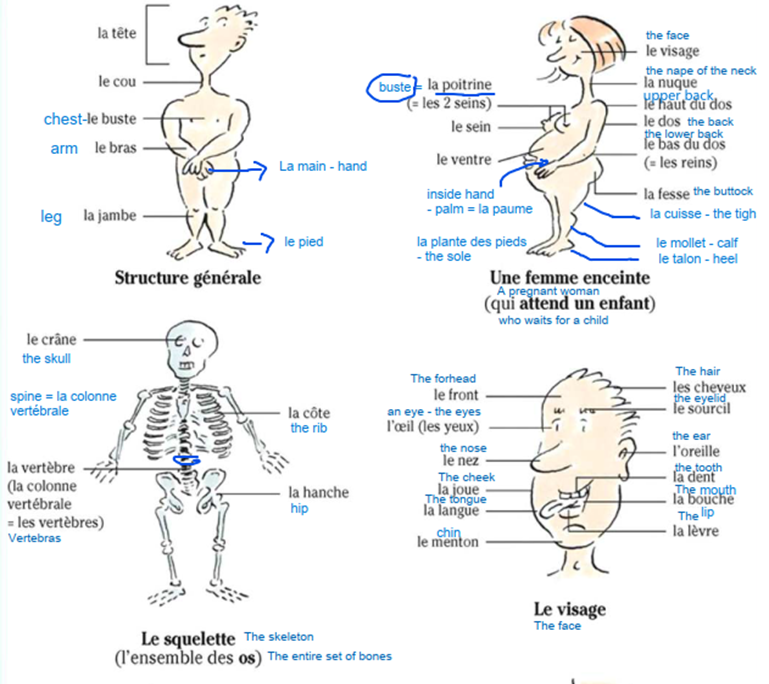
Parts of the body in French
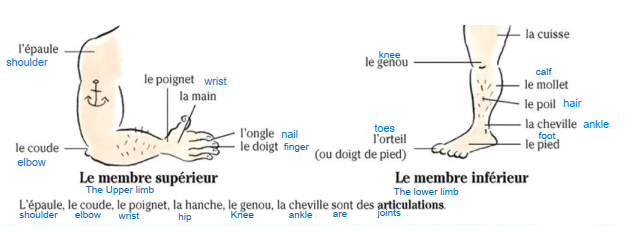
Upper and Lower limb vocabulary in French
Exercise : Guess and complete
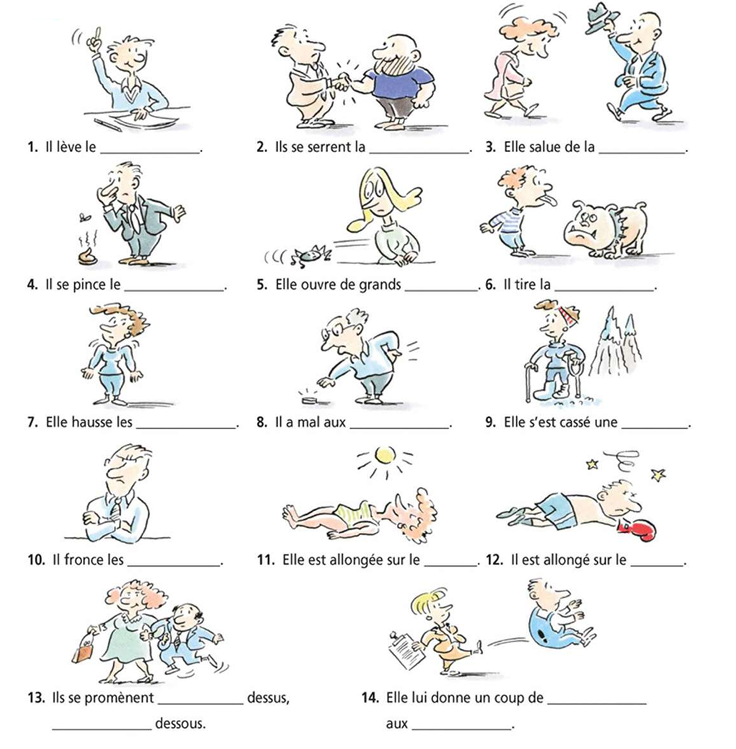
French Vocabulary exercises related to the body and health
Translation
- He raises his ______
- They hug each other______
- She waves______
- He pinches his______
- She opens her______
- He pulls his______
- She raises her______
- He has sore______
- She broke one______
- He frowns______
- She is lying on the______
- He is lying on the______
- They walk on top of ______underneath.______
- She gives him a tap _________
Eliminate the intruder
- forehead/eyebrow/neck/eye
- rib/toe/finger/nail
- tongue/tooth/lip/vertebra
- hair/ankle/body hair/eyebrow
- back/buttocks/nose/kidney
- forehead/chin/breast/cheek
- face/elbow/wrist/knee
- skull/head/face/spine
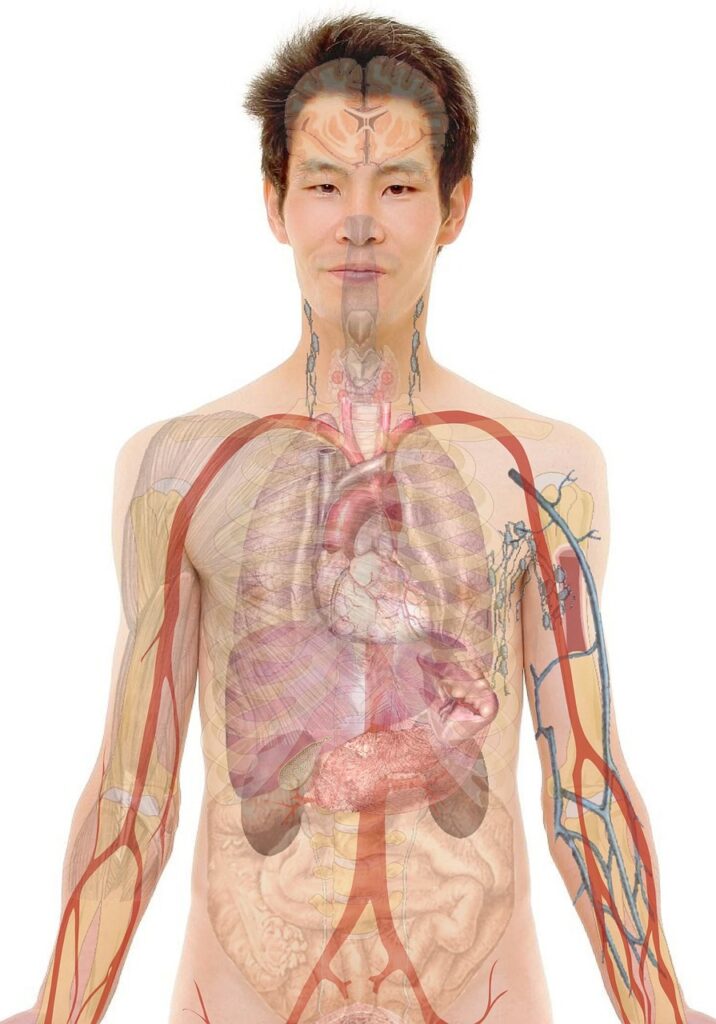
Vocabulary related to the body and health in French
The five senses
La vue – Sight
Elle a une bonne vue, elle a de bons yeux, elle voit bien. She has good eyesight, she has good eyes, she sees well.
Sa grand-mère, qui est très âgée, est devenue malvoyante, puis aveugle, (= elle ne voit plus du tout). Her grandmother, who is very old, became visually impaired, then blind (= she can no longer see at all).
Regarder / voir – To look / to see
Est-ce que la clé de la voiture est dans le salon ? Is the car key in the living room?
J’ai bien regardé partout, mais je ne l’ai pas vue. Pourtant, je vois clair ! I looked everywhere, but I didn’t see it. Yet, I can see clearly!
Le regard = l’expression des yeux → Il a un beau regard. The gaze = the expression in the eyes → He has a beautiful gaze.
L’ouïe – Hearing
Olivier est musicien. Il a une très bonne oreille, il a l’ouïe fine (= il entend très bien). Beethoven, qui était un compositeur célèbre, est devenu malentendant puis sourd (= il n’entendait plus du tout). Olivier is a musician. He has a very good ear, he has keen hearing (= he hears very well). Beethoven, who was a famous composer, became hard of hearing and then deaf (= he could no longer hear at all).
Écouter / entendre – To listen / to hear
Je n’ai pas entendu le bruit parce que j’écoutais la radio. I didn’t hear the noise because I was listening to the radio.
Moi, je l’ai entendu parce que je tendais l’oreille (= j’écoutais très attentivement). I heard it because I was straining my ears (= I was listening very carefully).
L’odorat – Sense of smell
Les chiens ont l’odorat très développé : ils sentent toutes les odeurs. Dogs have a very well-developed sense of smell: they can smell all kinds of odors.
Ça sent bon↑ ça sent mauvais (= ça pue*). It smells good ↑ It smells bad (= it stinks*).
Le goût – The taste
Est-ce que tu sens le goût de la vanille ? Can you taste the vanilla?
Attends, je goûte. (…) C’est bon (= ça a bon goût) ! Wait, let me taste it. (…) It’s good (= it tastes good)!
Moi aussi, je veux goûter ! (…) Ah ! Non ! Ce n’est pas bon (= ça a mauvais goût). Tu as mis beaucoup trop de vanille ! I want to taste it too! (…) Oh! No! It’s not good (= it tastes bad). You put way too much vanilla!
Remarque. Ne confondez pas : « Ces tomates n’ont aucun goût » (= elles sont fades) avec : « Tim n’a aucun goût » (= il ne fait pas la différence entre ce qui est beau et ce qui est laid).
Note. Don’t confuse: “These tomatoes have no taste” (= they are bland) with: “Tim has no taste” (= he can’t tell the difference between what is beautiful and what is ugly).
Le toucher – the touch
On touche, on caresse avec la main. We touch, we caress with our hand

The 5 senses in French
To which sense does each of the following sentences refer?
- Hum ! Ça sent bon ici ! ___________________________
- Ce tissu est chaud, mais surtout très doux, n’est-ce pas ? ___________________________
- Dans ces images, observez bien les couleurs. ___________________________
- Ce gâteau est absolument délicieux ! ___________________________
- Cette chanteuse interprète merveilleusement Mozart. ___________________________
- Ce parfum sent vraiment très fort. ___________________________
- C’est vraiment fade, ça manque de sel___________________________
Translation
- Mmm! It smells good in here!
- This fabric is warm, but above all, very soft, isn’t it?
- In these pictures, look closely at the colors.
- This cake is absolutely delicious!
- This singer performs Mozart wonderfully.
- This perfume smells really strong.
- It’s really bland; it needs more salt
Complete with the verb to see:voir, to look: regarder, to hear: entendre or to listen: écouter.
- Je suis allé à _____________un concert assez médiocre : on_____________ très peu le violon.
- Elle_____________ le tableau avec beaucoup d’attention.
- Avec ce brouillard, on ne _____________pas à dix mètres !
- Cet appartement est très bruyant : on_____________ beaucoup la circulation.
- J’aime bien ce médecin car il prend le temps d’_____________ ses patients.
- Tu n’arrêtes pas de_____________ ta montre. Tu t’ennuies ? Tu es pressé ?
- Gérard a de gros problèmes avec ses yeux : il _____________de moins en moins bien.
- _____________! Il y a une mouche dans la salade !
Translation
- I went to a _________rather mediocre concert: there was _________very little violin.
- She _________looked at the painting very carefully.
- With this fog, you can’t _________ ten meters!
- This apartment is very noisy: we_________ lot of traffic noise.
- I like this doctor because he takes the time _________ his patients.
- You keep _________ your watch. Are you bored? Are you in a hurry?
- Gérard has serious problems with his eyes: his_________ getting worse and worse.
- _________! There’s a fly in the salad!
So tell me in the comments, how did it go for you?
Send me your exercises and will correct.
French translation of the post
Aujourd’hui une petite leçon de vocabulaire sur le corps et la santé. Et oui, même si vous faites des fautes de grammaire mais que vous avez beaucoup de vocabulaire, vous pourrez facilement vous faire comprendre!
Cette leçon de vocabulaire concerne la santé et le corps. C’est tellement utile lorsqu’on doit aller chez le docteur et exprimer où on a mal.
Ce que tu vas apprendre :
Dans cette leçon tu vas apprendre :
– les différentes parties du corps
– Les différentes sens
– Revoir la structure de phrase simple
– Des exercices pour mémoriser le vocabulaire et faire des phrases
Allez c’est parti!