
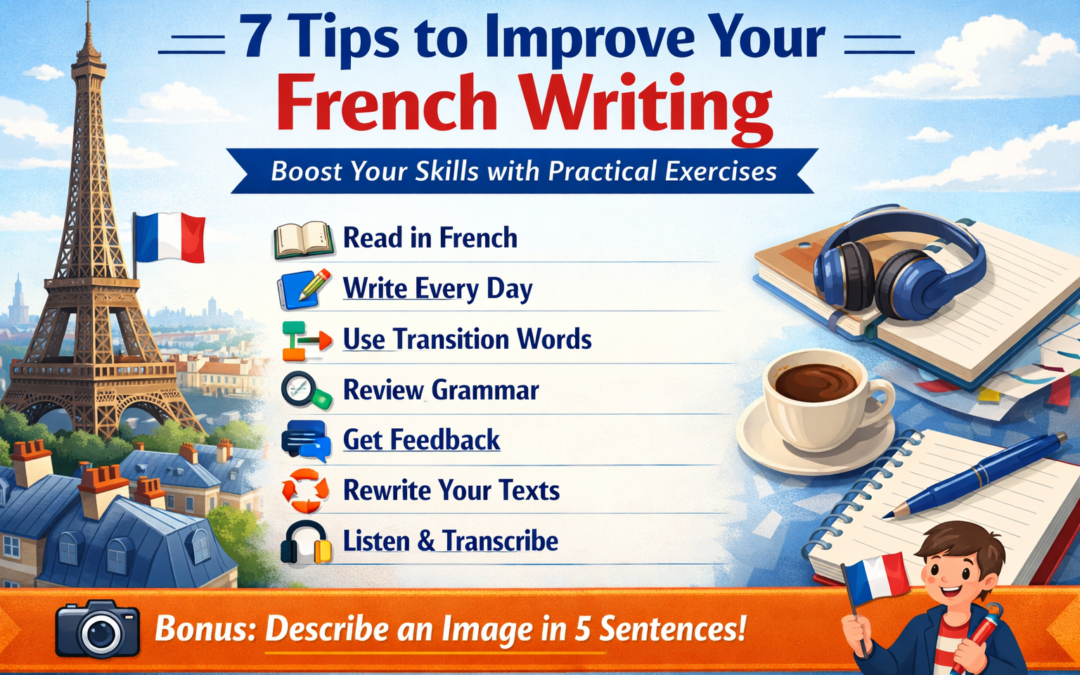
Improve your Writing in French can feel difficult, even if you already understand the language. You may know vocabulary but struggle to build sentences. Or you may write correctly but lack flow and natural expression. The truth is that improving your French writing is not about writing long essays — it’s about building small, consistent habits.
With the right techniques, you can quickly improve your clarity, grammar, and confidence. Below are 7 practical tips that will help you write better in French, along with simple exercises you can use immediately.

Read in French Every Day
Reading helps you absorb correct sentence patterns naturally. The more you read, the more your brain recognizes how French sentences are structured. This makes writing easier and more natural.
You don’t need to read complex books. Start with:
- short blog articles
- dialogues
- short stories
- social media posts
- simple news articles
While reading, pay attention to:
- word order
- verb tenses
- connectors
- useful expressions
Instead of just reading passively, try to actively notice how sentences are built.
Pro tip: keep a notebook and write down interesting phrases you want to reuse later.
Exercise
Read a short text in French and:
- write 3 new words
- copy 1 useful sentence
- write a 1-sentence summary
Write a Little Every Day
Daily writing is one of the fastest ways to improve. You don’t need to write a lot. Even 5 sentences per day is enough to build progress.
You can write:
- a daily journal
- your plans for tomorrow
- what you did yesterday
- a short story
- a description of your city
The key is consistency. Writing regularly helps you:
- think faster in French
- remember vocabulary
- reduce grammar mistakes
- build confidence
Pro tip: choose a specific time each day to write, like morning or evening.
Exercise
Write 5 sentences about:
- your day
- your routine
- your weekend
Use Transition Words to Improve Flow
Many learners write short, disconnected sentences. Using connectors helps your text sound more natural and structured.
Here are useful transition words:
Adding information
- de plus
- également
- en outre
Cause
- parce que
- puisque
- à cause de
Consequence
- donc
- alors
- c’est pourquoi
Contrast
- mais
- cependant
- pourtant
Conclusion
- en conclusion
- pour résumer
Using these words makes your writing smoother and more professional.
Pro tip: avoid writing one sentence per line. Try combining ideas using connectors.
Exercise
Combine the sentences:
Je suis fatigué.
Je travaille beaucoup.
Try with:
- parce que
- donc
- mais
Focus on Grammar and Agreements
Grammar mistakes are part of learning, but reviewing them helps you improve faster. The most common errors in French writing include:
- subject–verb agreement
- adjective agreement
- verb tense confusion
- gender mistakes
- plural forms
You don’t need to master everything at once. Focus first on essential tenses:
- present
- passé composé
- imparfait
- futur proche
When you finish writing, reread your text slowly and check:
- verbs
- endings
- agreements
- articles
Pro tip: read your text out loud. You’ll often hear mistakes more easily.
Exercise
Correct the mistakes:
- Elle sont très heureux.
- Nous mange au restaurant hier.
- Je vais au marché et j’ai acheté des fruit.

Get Feedback on Your Writing
Writing alone is helpful, but feedback accelerates improvement. Someone else can quickly spot errors you don’t see.
You can:
- ask a teacher
- exchange with a language partner
- join online communities
- use correction tools
Feedback helps you:
- identify recurring mistakes
- learn natural expressions
- improve clarity
- expand vocabulary
Pro tip: keep a list of your most common mistakes and review it regularly.
Exercise
Write a short paragraph (5–6 sentences) and:
- ask for correction
- rewrite the corrected version
- compare both
Rewrite Your Texts
Rewriting is one of the most powerful learning techniques. Instead of always writing new texts, improve old ones.
When rewriting:
- shorten long sentences
- replace repeated words
- add connectors
- improve verb choice
- simplify structure
Example:
First version:
Je suis allé à Paris. C’était bien. J’ai vu des monuments. J’ai mangé.
Improved version:
Je suis allé à Paris et j’ai visité plusieurs monuments. J’ai aussi goûté la cuisine locale, et l’expérience était très agréable.
This technique helps you see progress clearly.
Exercise
Rewrite this paragraph:
Je vais au restaurant. C’est bon. Je mange avec mes amis. Je suis content.
Listen and Transcribe
Listening improves writing more than most learners expect. When you listen carefully and write what you hear, you train:
- spelling
- grammar
- punctuation
- sentence structure
Try this method:
- Listen to a short audio
- Write what you hear
- Check subtitles
- Correct mistakes
- Rewrite the text
This combines listening and writing practice.
Pro tip: start with slow videos or beginner podcasts.
Exercise
Listen to a short video and:
- write 3 sentences
- write 1 summary
- rewrite in your own words
Bonus: Quick Writing Challenges
Try these simple exercises:
Challenge 1
Describe an image in 5 sentences.
Challenge 2
Rewrite using different words:
Je me réveille tôt. Je bois du café. Je vais travailler. Je suis fatigué.
Challenge 3
Write:
- 5 common mistakes you make
- the correct version
Final Thoughts
Improving your French writing takes time, but small daily practice makes a big difference. Read often, write regularly, use connectors, and don’t be afraid of mistakes. The more you write, the more natural French will become.
Start today: write 5 sentences in French right now. Consistency is the key to progress.