
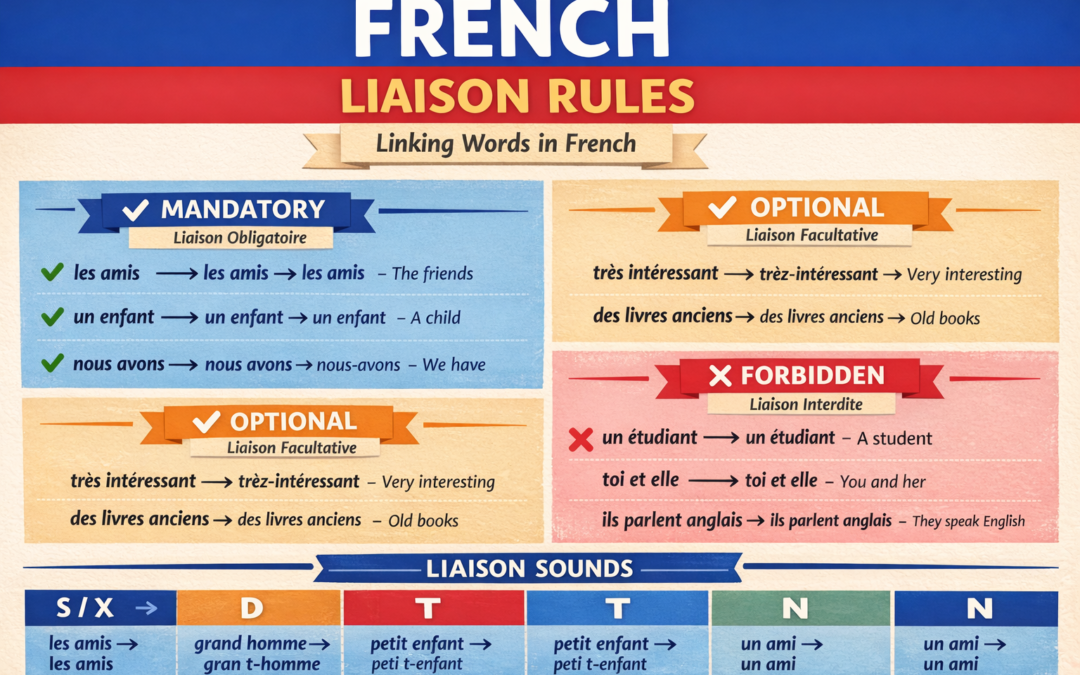
One of the most distinctive features of spoken French is liaison. If you have ever listened to native speakers, you may have noticed that words often seem to connect smoothly together.
For example, instead of saying:
les amis
as two separate words, French speakers pronounce it like:
les-z-amis
This phenomenon is called liaison.
For many learners, liaison can feel confusing at first. When should you pronounce it? When should you avoid it? And how does it change pronunciation?
In this guide, you will learn:
- what liaison is
- when it is mandatory
- when it is optional
- when it is forbidden
- examples with English translations
- exercises to practice
By the end of this article, you will understand how liaison works in everyday French speech.
What Is Liaison in French?

A liaison happens when a normally silent final consonant is pronounced because the next word begins with a vowel or a silent h.
This consonant is then linked to the following word.
Example
les amis
Pronunciation:
les-z-amis
French sentence:
Les amis arrivent.
English translation:
The friends are arriving.
Without liaison, the sentence would sound unnatural.
Liaison helps French sound more fluid and rhythmic.
Why Liaison Is Important
Liaison is essential for two main reasons.
First, it makes pronunciation sound natural. Native speakers use liaison constantly.
Second, it can sometimes change meaning or help listeners understand the structure of a sentence.
For example:
un grand homme
→ a great man
Pronunciation:
un gran-t-homme
The t sound connects the words.
Without liaison, the phrase would sound incomplete.
Mandatory Liaison (Liaison Obligatoire)

In some situations, liaison is required. Not making it may sound incorrect or very unnatural.
Let’s look at the most common cases.
1. Between Determiners and Nouns
When a determiner is followed by a noun beginning with a vowel, liaison is mandatory.
Examples
les enfants
Pronunciation:
les-z-enfants
Sentence:
Les enfants jouent.
Translation:
The children are playing.
un ami
Pronunciation:
un-n-ami
Sentence:
J’ai un ami à Paris.
Translation:
I have a friend in Paris.
2. Between Adjectives and Nouns
When an adjective comes before a noun starting with a vowel.
Example:
un petit enfant
Pronunciation:
peti-t-enfant
Sentence:
C’est un petit enfant.
Translation:
He is a small child.
3. Between Pronouns and Verbs
Liaison also appears between subject pronouns and verbs.
Examples:
Nous avons
Pronunciation:
nou-z-avons
Sentence:
Nous avons terminé.
Translation:
We have finished.
Vous êtes
Pronunciation:
vou-z-êtes
Sentence:
Vous êtes prêts.
Translation:
You are ready.
4. Between Verb and Object Pronoun
Example:
donnez-en
Pronunciation:
donnez-z-en
Sentence:
Donnez-en deux.
Translation:
Give two of them.
Optional Liaison (Liaison Facultative)
In some cases, liaison is optional. Native speakers may pronounce it in formal speech but skip it in casual conversation.
1. After Plural Nouns
Example:
des étudiants intelligents
Pronunciation:
des étudiants-z-intelligents (formal)
Sentence:
Ce sont des étudiants intelligents.
Translation:
They are intelligent students.
In casual speech, many speakers omit this liaison.
2. After Certain Adverbs

Example:
très intéressant
Pronunciation:
trè-z-intéressant
Sentence:
Ce livre est très intéressant.
Translation:
This book is very interesting.
The liaison is often pronounced but can be dropped in informal speech.
Forbidden Liaison (Liaison Interdite)
Some liaisons must never be pronounced, even if a vowel follows.
These are very important to remember.
1. After Singular Nouns
Example:
un étudiant arrive
Correct pronunciation:
un étudiant arrive
Incorrect:
un étudiant-t-arrive ❌
Sentence:
Un étudiant arrive.
Translation:
A student arrives.
2. After “et”
The conjunction et (and) never forms a liaison.
Example:
toi et elle
Correct pronunciation:
toi et elle
Incorrect:
toi et-t-elle ❌
Translation:
You and her
3. After Certain Verb Forms
Example:
ils parlent anglais
Correct pronunciation:
ils parlent anglais
Incorrect:
ils parlent-t-anglais ❌
Translation:
They speak English.
Common Liaison Sounds
When liaison happens, the silent consonant becomes pronounced.
Here are the most common sounds.
| Spelling | Liaison sound | Example |
| s / x | z | les amis → les-z-amis |
| d | t | grand homme → gran-t-homme |
| t | t | petit enfant → peti-t-enfant |
| n | n | un ami → un-n-ami |
Learning these patterns helps you predict how liaison works.
Liaison in Everyday French
Native speakers use liaison frequently, but they do not always pronounce every possible one.
Formal speech tends to include more liaisons, while casual conversations include fewer.
For example:
Formal speech:
Nous avons un ami important.
Pronunciation:
nou-z-avon-z-un-n-ami important
Translation:
We have an important friend.
Understanding this variation helps learners sound more natural.
Exercises

Now it’s time to practice.
Exercise 1 – Identify the Liaison
Which sentences require liaison?
- les amis arrivent
- toi et elle
- nous avons fini
- un étudiant arrive
- très intéressant
Exercise 2 – Pronunciation
Add the liaison sound.
Example:
les amis → les-z-amis
- un ami
- vous êtes
- petit enfant
- très intéressant
- nous avons
Exercise 3 – Translate Into English
- Les enfants arrivent.
- Nous avons un ami.
- C’est très intéressant.
- Vous êtes en retard.
- Un étudiant arrive.
Corrections
Exercise 1
- les amis arrivent → liaison ✔
- toi et elle → no liaison ✔
- nous avons fini → liaison ✔
- un étudiant arrive → no liaison ✔
- très intéressant → optional liaison ✔
Exercise 2
- un-n-ami
- vou-z-êtes
- peti-t-enfant
- trè-z-intéressant
- nou-z-avons
Exercise 3
- Les enfants arrivent.
→ The children are arriving. - Nous avons un ami.
→ We have a friend. - C’est très intéressant.
→ It is very interesting. - Vous êtes en retard.
→ You are late. - Un étudiant arrive.
→ A student arrives.
Conclusion
Liaison is one of the most important features of French pronunciation.
Although it may seem complicated at first, it follows clear patterns. By learning the rules for mandatory, optional, and forbidden liaison, you will improve both your listening and speaking skills.
Most importantly, practice listening to native speakers and repeating sentences aloud.
Over time, liaison will start to feel natural—and your French will sound much more fluent and authentic.
A bientôt
Julie