
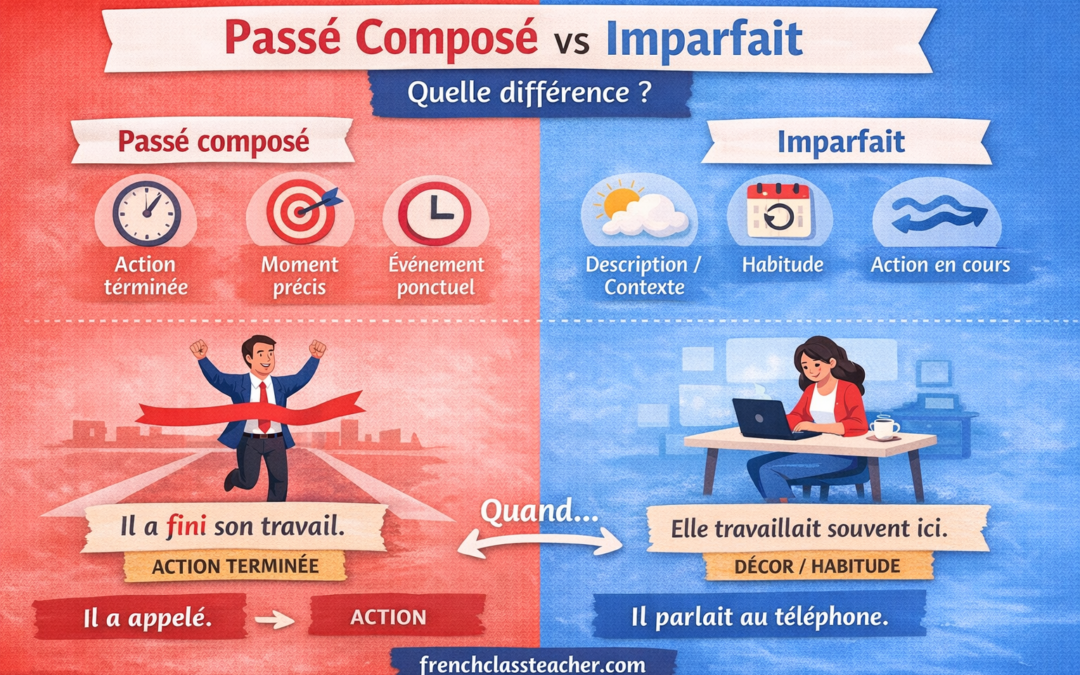
One of the biggest difficulties for French learners at B1 level is understanding the difference between the passé-composé and the imparfait.
Both tenses talk about the past…
But they are not used in the same way.
And often, the problem is not conjugation.
The real problem is choosing the correct tense.
In this article, you will learn:
- When to use the passé composé
- When to use the imparfait
- How to use them together
- Common mistakes to avoid
- Simple tips to stop hesitating
- Corrected exercises
Ready? Let’s begin.
The Passé Composé: Completed and Specific Action
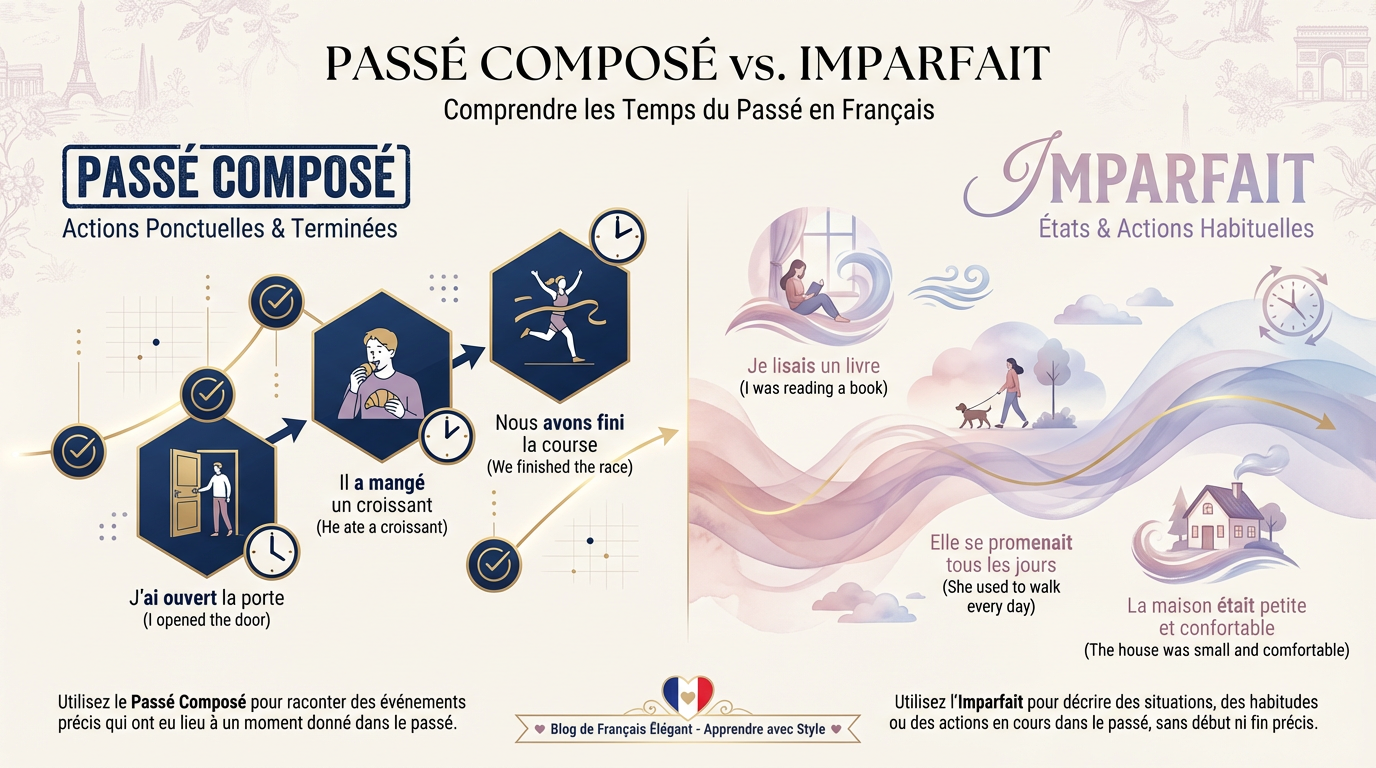
The passé composé is used to talk about a finished, complete, and generally short action.
We use it to tell what happened.
It is used for:
- A completed action
- A specific event
- A short action
- A sequence of actions
Simple examples:
- Hier, j’ai travaillé. Yesterday, I worked.
- Elle est partie à 18h. She left at 6 p.m.
- Nous avons regardé un film. We watched a movie.
- Il a ouvert la porte. He opened the door.
In these sentences, the action is clearly finished.
You can often add:
- A date: En 2022. In 2022.
- A time: Hier. Yesterday.
- A precise moment. Ce matin. This morning, La semaine dernière. Last week.
Important Tip
If you can answer the question: “What happened?”
The answer is often in the passé composé.
The Imparfait: Description, Habit, and Context
The imparfait is different.
It does not tell the main action.
It gives the background, the description, or talks about a habit.
We use the imparfait to:
- Describe a situation in the past
- Talk about the weather
- Describe feelings
- Talk about habits
- Talk about a long or ongoing action
Examples:
- Quand j’étais petit, je jouais au football.When I was little, I used to play football.
- Il faisait beau The weather was nice.
- Nous habitions à Paris.We lived in Paris.
- Elle était fatiguée. She was tired..
- Tous les jours, je prenais le bus. Every day, I took the bus.
Here, we are not talking about a single event.
We are talking about context or repeated action.
Simple Tip
If you can ask the question: “What was it like?”
The answer is often in the imparfait.
The Fundamental Difference
The main difference is the following:
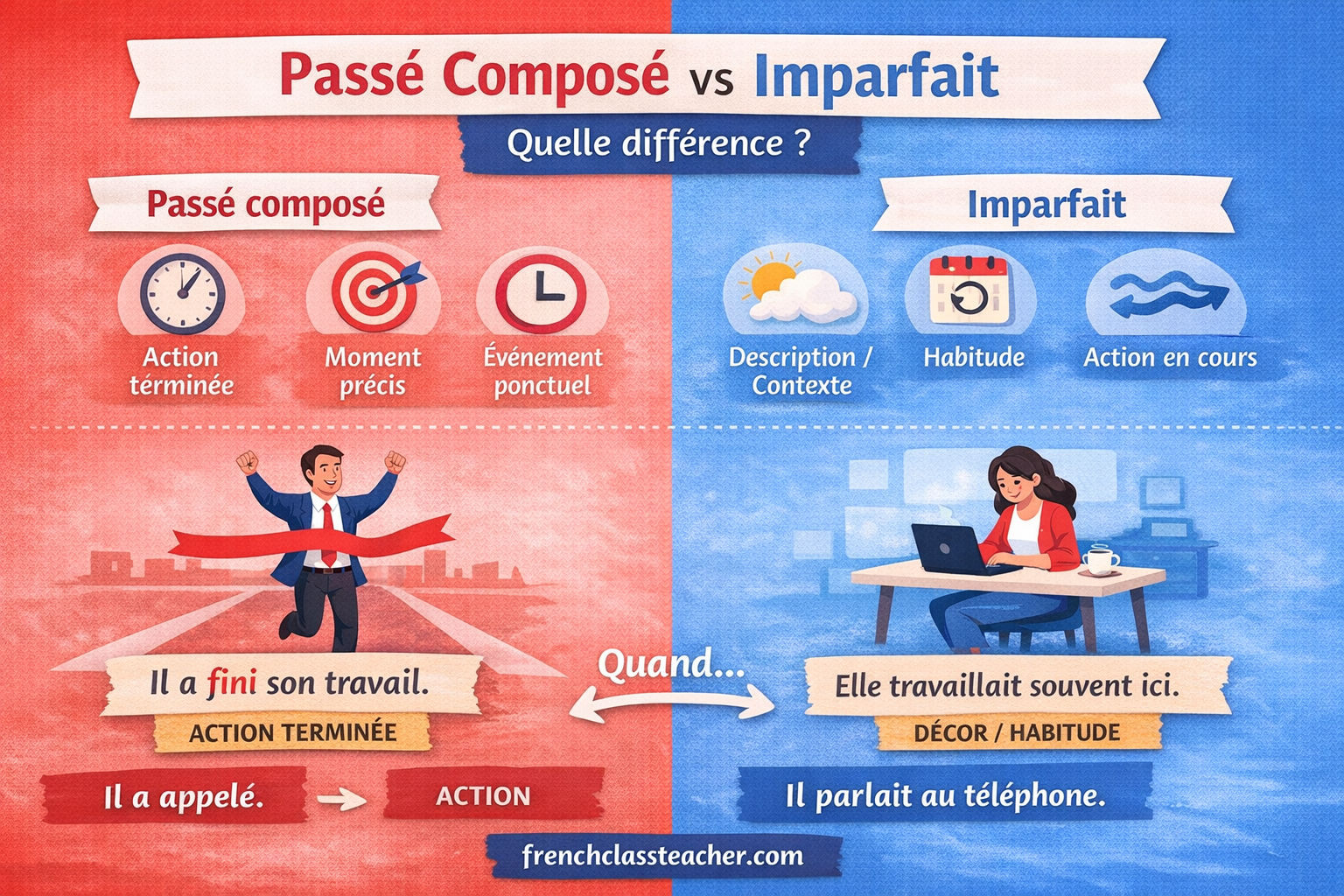
| Passé Composé | Imparfait |
| Completed action | Description |
| Specific event | Context |
| Short action | Long action |
| Main action | Background |
Using Both Together
Very often, we use both tenses in the same sentence.
Why?
Because the imparfait sets the scene and the passé composé tells the important action.
Example 1
I was watching television when the phone rang. Je regardais la télévision quand le téléphone a sonné.
- – regardais- was watching → imparfait (ongoing action)
- – a sonné – rang → passé composé (sudden action)
The phone interrupts the action.
Example 2
It was raining when I went out. Il pleuvait quand je suis sorti.
- – pleuvait – was raining → description
- – suis sorti – went out → precise action
Example 3
Nous dînions quand il est arrivé.We were having dinner when he arrived.
Same logic:
- imparfait = action in progress
- passé composé = interruption
Habits in the Past
Be careful: habits use the imparfait.
Incorrect:
Quand j’étais jeune, j’ai joué au football. When I was young, I played football.
Correct:
Quand j’étais jeune, je jouais au football. When I was young, I used to play football.
Why?
Because it was a repeated action.
Signal words for the imparfait:
Often ->Souvent
Always ->Toujours
Every day ->Tous les jours
Every week -> Chaque semaine
At that time -> À cette époque
Successive Actions
When telling a story with several actions that move the story forward, we use the passé-composé.
Example:
Je me suis levé, j’ai pris une douche, j’ai bu un café et je suis parti. => I got up, I took a shower, I drank coffee, and I left.
These are finished actions, one after the other.
Physical and Emotional Description
Descriptions are almost always in the imparfait.
Examples:
- Il était grand et portait des lunettes. He was tall and wore glasses.
- Elle semblait stressée. She seemed stressed.
- Nous étions heureux.We were happy.
Common Mistakes
Mistake 1: Using passé composé for description
Incorrect:
Il a fait beau et j’ai été fatigue. The weather was nice and I was tired.
Correct:
Il faisait beau et j’étais fatigué. The weather was nice and I was tired.
Mistake 2: Using imparfait for a specific action
Incorrect:
Hier, je regardais un film au cinéma. Yesterday, I was watching a movie at the cinema.
Correct:
Hier, j’ai regardé un film. Yesterday, I watched a movie.
Visual Tip: The Movie Scene
Imagine a movie scene.
The imparfait = the setting, the lighting, the atmosphere.
The passé composé = the important action.
Example:
La nuit était sombre. Il pleuvait. The night was dark. It was raining.
Soudain, un homme a frappé à la porte. Suddenly, a man knocked on the door.
Can you see the difference?
Question Method
When you hesitate, ask yourself these 3 questions:
- Am I describing a situation? → Imparfait
- Is it a habit? → Imparfait
- Is it a finished and specific event? → Passé composé
B1 Level Exercises
Exercise 1
Choose the correct tense:
- Quand j’_______ (être) enfant, je _______ (aller) à l’école à pied.
- Hier, nous _______ (manger) au restaurant.
- Il _______ (faire) froid quand elle _______ (arriver).
- Tous les étés, nous _______ (voyager) en Espagne.
- Soudain, il _______ (tomber).
- When I _______ (be) a child, I _______ (go) to school on foot.
- Yesterday, we _______ (eat) at a restaurant.
- It _______ (be cold) when she _______ (arrive).
- Every summer, we _______ (travel) to Spain.
- Suddenly, he _______ (fall).
Answers
- étais / allais
- avons mangé
- faisait / est arrivée
- voyagions
- est tombé
Exercise 2: Tell a Story
Complete with the correct tense:
Il _______ (faire) nuit. Je _______ (marcher) dans la rue quand soudain je _______ (entendre) un bruit étrange.
It _______ (be) night. I _______ (walk) in the street when suddenly I _______ (hear) a strange noise.
Answer:
Il faisait nuit. Je marchais dans la rue quand soudain j’ai entendu un bruit étrange. It was night. I was walking in the street when suddenly I heard a strange noise.
Quick Summary
Imparfait:
- description
- habit
- long action
- background
Passé composé:
- completed action
- specific event
- short action
- sequence of actions
Why Is This Difference Important?
Because it changes the meaning.
Compare:
Je dormais. I was sleeping.
J’ai dormi. I slept.
The first describes an ongoing action.
The second indicates that the action is completed.
Conclusion
The passé composé and the imparfait are not enemies.
They work together.
The imparfait creates the atmosphere.
The passé composé moves the story forward.
At first, it’s normal to hesitate.
But with practice, your brain will recognize the logic.
And soon, you will use these two tenses naturally.
More practice here, on FrenchClass Teacher.
And for listening practice, listen to my Podcast
A bientôt
Julie