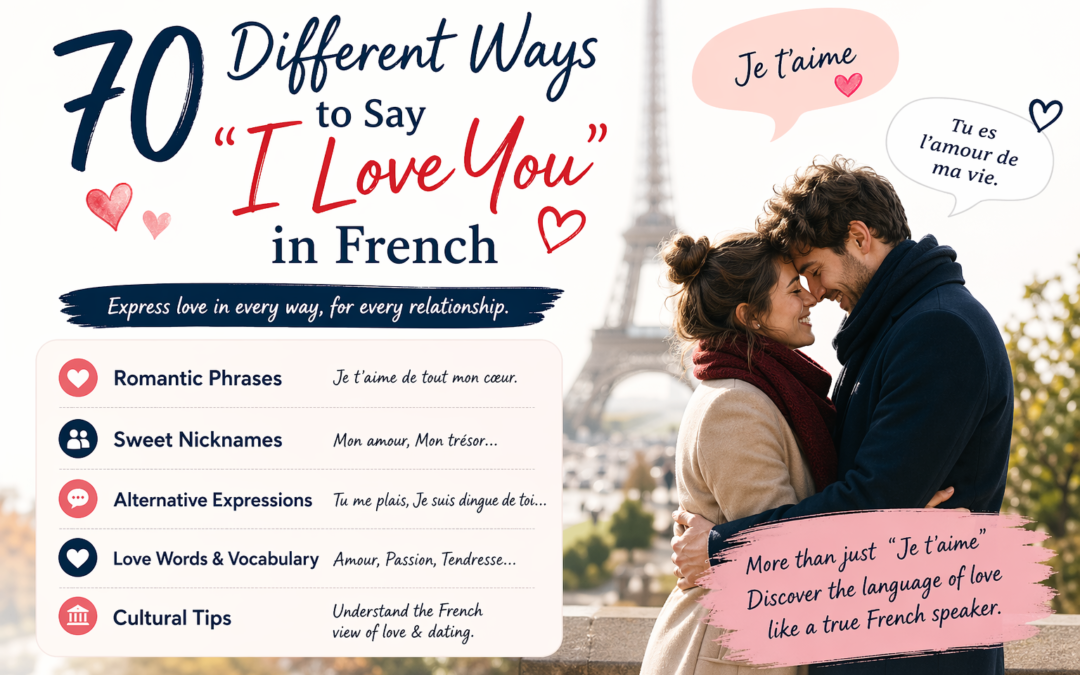
Love is universal — but the way we express it is deeply cultural. If you’ve ever tried to say “I love you” in French, you might think it’s simple: just say Je t’aime.
But in reality, it’s not that straightforward.
French is a language of nuance, emotion, and precision. The same verb aimer can express deep romantic love, friendship, or simple appreciation — depending on how you use it.
In this guide, you’ll discover different ways to express love in French, from romantic declarations to subtle expressions, along with cultural insights to help you avoid common mistakes.
Table of Contents
- What does “I love you” really mean in French?
- When should you say je t’aime?
- 10 classic ways to say “I love you”
- 15 softer alternatives (when it’s too early)
- 10 romantic and poetic expressions
- 10 cute nicknames (terms of endearment)
- 10 everyday love expressions
- 15 essential love-related words
- Friendship vs romantic love in French
- Cultural tips: love, dating, and communication
- Final thoughts

What Does “I Love You” Really Mean in French?
The standard translation is:
Je t’aime
However, this is where many learners make a mistake.
In French, this sentence usually means:
“I am in love with you”
This is much stronger than in English, where “I love you” is used more freely with friends and family.
So before using it, it’s important to understand the context.
When Should You Say Je t’aime?
Now that you understand the meaning, let’s talk about usage.
French speakers don’t use je t’aime casually. It is typically reserved for:
- romantic relationships
- very close family
- meaningful emotional moments
In other words, timing matters.
Saying it too early can feel intense — which is why learners often need alternatives.

10 Classic Ways to Say “I Love You”
Let’s start with the most direct expressions.
These phrases clearly express strong romantic feelings:
- Je t’aime — I love you
- Je t’aime de tout mon cœur — I love you with all my heart
- Je suis amoureux / amoureuse de toi — I’m in love with you
- Tu es l’amour de ma vie — You are the love of my life
- Je t’aime passionnément — I love you passionately
- Je t’aime à la folie — I’m crazy about you
- Tu comptes énormément pour moi — You mean so much to me
- Je ne peux pas vivre sans toi — I can’t live without you
- Tu es tout pour moi — You are everything to me
- Je t’aimerai toujours — I will always love you
But what if you’re not ready to say something this strong?
Let’s explore softer alternatives.
15 Softer Alternatives (When It’s Too Early)
In many situations, especially at the beginning of a relationship, you may want to express affection without sounding too intense.
These expressions allow you to stay emotionally honest — without saying je t’aime:
- Je t’aime bien — I like you
- Je t’aime beaucoup — I like you a lot
- Tu me plais — I like you (romantically)
- Tu me plais beaucoup — I really like you
- J’ai un faible pour toi — I have a soft spot for you
- Je tiens à toi — I care about you
- Tu es important(e) pour moi — You are important to me
- Je suis bien avec toi — I feel good with you
- J’adore passer du temps avec toi — I love spending time with you
- Tu me rends heureux / heureuse — You make me happy
- Je pense souvent à toi — I think about you often
- Tu me manques — I miss you
- J’aime être avec toi — I like being with you
- On est bien ensemble — We’re good together
- Je suis attaché(e) à toi — I’m attached to you
Once your feelings grow stronger, you might want to sound more expressive or poetic.
10 Romantic and Poetic Expressions
French is known as the language of love — and these expressions show why.
Use them to add emotion, intensity, or even a bit of drama:
- Mon cœur bat pour toi — My heart beats for you
- Tu es ma raison de sourire — You are my reason to smile
- Je rêve de toi — I dream of you
- Tu illumines ma vie — You light up my life
- Je suis fou / folle de toi — I’m crazy about you
- Je suis dingue de toi — I’m crazy about you (casual)
- Tu es mon destin — You are my destiny
- Je veux être avec toi pour toujours — I want to be with you forever
- Tu es mon bonheur — You are my happiness
- Je t’aime plus que tout — I love you more than anything
But love in French isn’t only about big declarations — it’s also about everyday affection.
10 Cute Nicknames (Terms of Endearment)
French speakers often express love through nicknames.
These small words can make your speech sound instantly more natural:
- Mon amour — My love
- Mon cœur — My heart
- Mon trésor — My treasure
- Mon ange — My angel
- Mon chou — My sweetie
- Mon chaton — My kitten
- Mon bébé — My baby
- Ma puce — My darling
- Mon lapin — My bunny
- Doudou — Sweetie
And beyond nicknames, French people also use simple, everyday expressions to show care.
10 Everyday Love Expressions
Not every situation requires a dramatic declaration.
These phrases are natural, frequent, and very useful:
- Je t’adore — I adore you
- Tu me fais sourire — You make me smile
- J’aime ta façon de penser — I like the way you think
- Tu es spécial(e) — You are special
- Tu es incroyable — You are amazing
- Je suis fier / fière de toi — I’m proud of you
- Tu es unique — You are unique
- Tu comptes pour moi — You matter to me
- Je suis content(e) de t’avoir — I’m happy to have you
- Merci d’être là — Thank you for being here
To fully understand these expressions, you also need key vocabulary.
15 Essential Love-Related Words
These words will help you navigate conversations about love:
- L’amour — love
- L’amitié — friendship
- Un amoureux / une amoureuse — lover
- Un petit ami / une petite amie — boyfriend / girlfriend
- Un partenaire — partner
- Tomber amoureux — to fall in love
- Un rendez-vous — a date
- Se rencontrer — to meet
- S’embrasser — to kiss
- Un baiser — a kiss
- Une relation — a relationship
- Se marier — to get married
- Un mariage — a wedding
- Une rupture — a breakup
- Les sentiments — feelings
Now, let’s clarify one of the most important points for learners.
Friendship vs Romantic Love in French
This distinction is essential.
Je t’aime = romantic love
Je t’aime bien / beaucoup = friendship
A small difference — but a big impact.
Using the wrong one can completely change the meaning of your sentence.
Cultural Tips: Love, Dating, and Communication
Finally, understanding culture will help you sound natural.
- Love is not casual
French people use je t’aime with intention.
- Simplicity is powerful
Short, sincere phrases are preferred.
- Actions matter
Love is shown through gestures and presence.
- Relationships evolve naturally
There is less focus on “dating stages” than in some cultures.
In other words, language and culture go together.

Final Thoughts
Learning how to say “I love you” in French is not just about memorizing phrases it’s about understanding emotion, context, and nuance.
Start small
Choose a few expressions
Practice them out loud
Because in French, love is not just something you say
it’s something you express naturally, little by little.
Julie