
When you learn French, textbooks often teach you formal phrases like Comment allez-vous ? or Je ne sais pas.
But when you actually listen to French people speaking in everyday life, you quickly realize something: real French sounds very different.
Native speakers use many short, natural expressions that appear constantly in daily conversations.
If you learn these sentences, you will:
- understand spoken French more easily
- sound more natural
- feel more confident in conversations
In this guide, you’ll discover 50 French sentences that French people use every day, with English translations and practical examples.
Let’s start with the expressions you will hear constantly in daily conversations.
Basic Everyday Expressions

These are some of the most common sentences used in daily interactions. You will hear them in shops, at work, with friends, and in many casual conversations.
| French sentence | English translation |
| Ça marche. | That works. |
| Pas de problème. | No problem. |
| Ça va ? | How are you? |
| Ça va. | I’m good / It’s going well. |
| Pas mal. | Not bad. |
| Comme ci, comme ça. | So-so. |
| D’accord. | Okay / Alright. |
| Bien sûr. | Of course. |
| Exactement. | Exactly. |
| Je vois. | I see. |
These expressions are extremely useful because they help you react naturally during conversations.
But conversations don’t stop there. When people talk with friends or colleagues, they often express opinions and reactions.
Let’s look at some sentences that French speakers use to share their thoughts.
Expressing Opinions
In everyday conversations, French people frequently share their opinions about food, movies, work, or daily situations.
Here are some very common phrases.
| French sentence | English translation |
| Je pense que oui. | I think so. |
| Je ne pense pas. | I don’t think so. |
| À mon avis… | In my opinion… |
| Je trouve que… | I find that… / I think that… |
| Ça dépend. | It depends. |
| Franchement… | Honestly… |
| C’est clair. | That’s clear / Obviously. |
| C’est sûr. | That’s for sure. |
| Pourquoi pas ? | Why not? |
| Bonne idée. | Good idea. |
These expressions are especially helpful when you want to participate in conversations naturally.
However, daily conversations also involve many small reactions to what people say.
Let’s look at some of the most common ones.
Common Reactions
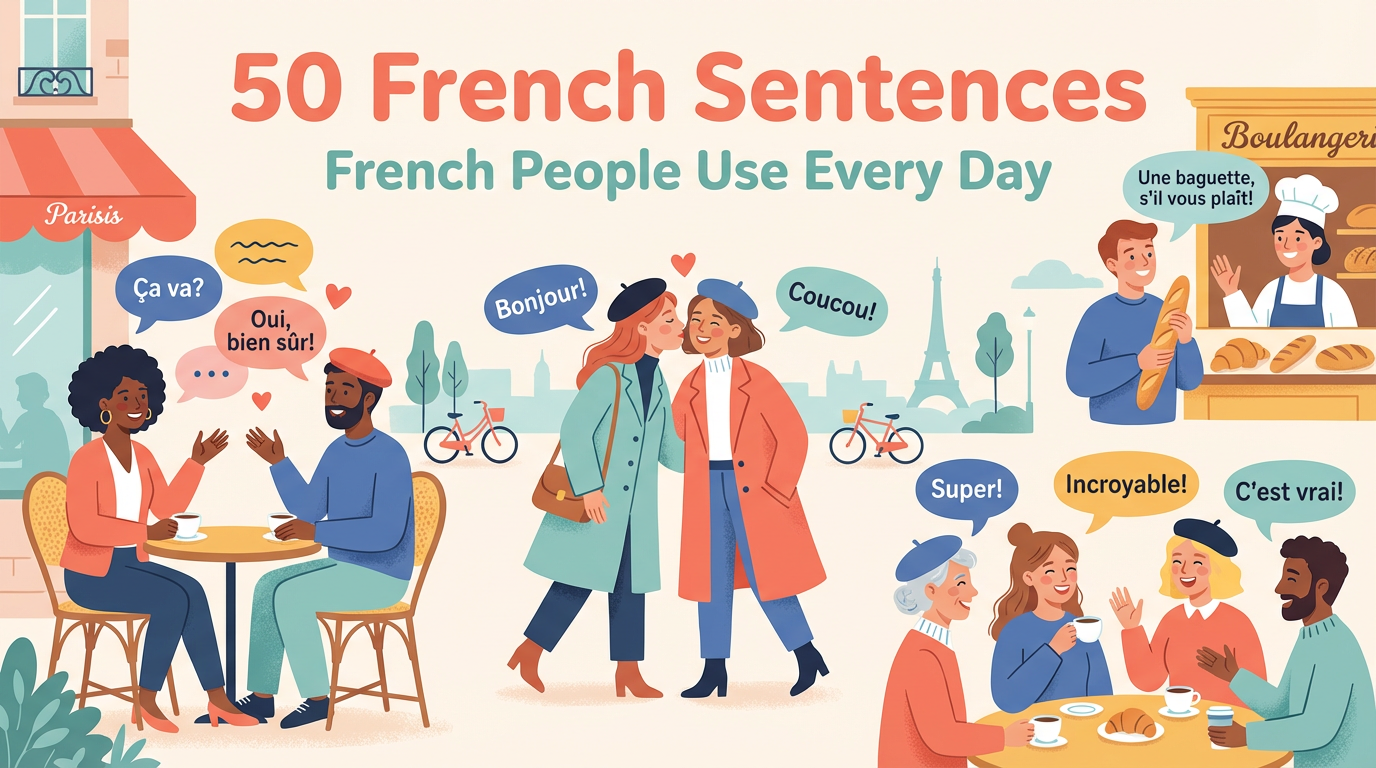
French people often use short expressions to react quickly in conversations.
Here are some phrases you will hear very often.
| French sentence | English translation |
| Ah bon ? | Really? |
| C’est vrai ? | Is that true? |
| Sérieux ? | Seriously? |
| Incroyable ! | Incredible! |
| Je te crois. | I believe you. |
| Je comprends. | I understand. |
| Tu vois ? | You see? |
| Je sais. | I know. |
| Moi aussi. | Me too. |
| Moi non plus. | Me neither. |
These expressions make conversations more dynamic and natural.
But everyday conversations also involve asking for help or making requests.
Let’s explore some useful sentences for those situations.
Asking for Things
When interacting with people in shops, restaurants, or daily situations, these phrases are extremely useful.
| French sentence | English translation |
| Je peux avoir… ? | Can I have… ? |
| Est-ce que je peux… ? | Can I… ? |
| Tu peux m’aider ? | Can you help me? |
| Tu peux répéter ? | Can you repeat? |
| Je n’ai pas compris. | I didn’t understand. |
| Ça veut dire quoi ? | What does it mean? |
| Comment on dit… ? | How do you say… ? |
| Tu peux parler plus lentement ? | Can you speak more slowly? |
| Attends une seconde. | Wait a second. |
| Donne-moi une minute. | Give me a minute. |
These sentences are extremely helpful for learners who are practicing French in real-life situations.
Of course, daily conversations also involve talking about plans and activities.
Let’s look at some common sentences used for that.
Talking About Plans
These expressions are often used when friends are making plans or discussing what they will do later.
| French sentence | English translation |
| On y va ? | Shall we go? |
| On se voit quand ? | When do we meet? |
| À quelle heure ? | At what time? |
| On se retrouve là-bas. | Let’s meet there. |
| Je suis en route. | I’m on my way. |
| J’arrive. | I’m arriving / I’m almost there. |
| Je suis en retard. | I’m late. |
| Ça te va ? | Does that work for you? |
| Ça me va. | That works for me. |
| À tout à l’heure. | See you later. |
By learning these phrases, you will be able to follow and participate in everyday conversations much more easily.
Now let’s practice what you’ve learned with some exercises.
Everyday French Fillers and Conversation Expressions
If you listen carefully to French conversations, you will notice something interesting: French people use many small expressions and fillers when they speak.
These expressions do not always have a precise meaning, but they help speakers:
- organize their thoughts
- react in conversations
- sound more natural and fluent
For learners, understanding these expressions is extremely important because they appear all the time in spoken French.
Let’s look at some very common ones.
| French sentence | English translation |
| Ben… | Well… |
| Bah oui. | Well yes / Of course. |
| Bah non. | Well no. |
| Tu vois. | You see. |
| En fait… | Actually… |
| Du coup… | So / therefore. |
| Genre… | Like… |
| Bon… | Well… |
| Bref. | Anyway. |
| Voilà. | That’s it / there you go. |
These small expressions might look simple, but they are essential to sounding natural in French.
For example, imagine someone telling a story:
Ben… hier j’étais au travail et du coup j’ai fini très tard.
This could be translated as:
Well… yesterday I was at work and so I finished very late.
In this sentence, ben and du coup help make the story sound more natural and conversational.
How French People Use Fillers in Conversation
Fillers often appear when people are thinking or explaining something.
For example:
Bon… je pense qu’on devrait partir.
Well… I think we should leave.
The word bon gives the speaker a moment to organize their thoughts before continuing.
Another very common example is en fait.
En fait, je ne travaille pas aujourd’hui.
Actually, I’m not working today.
This expression is used to correct or clarify something.
Another expression you will hear very often is du coup.
J’étais fatigué, du coup je suis resté à la maison.
I was tired, so I stayed at home.
While grammar books often suggest using donc or alors, in everyday speech many French people prefer du coup.
Expressions Used to End Conversations
French speakers also use certain phrases when they want to finish a conversation or move on to something else.
For example:
Bon, je dois y aller.
Alright, I have to go.
The word bon signals that the conversation is ending.
Another common expression is bref.
Bref, c’était une journée compliquée.
Anyway, it was a complicated day.
This word allows speakers to summarize or skip details.
Finally, the word voilà appears constantly in spoken French.
For example:
Voilà, c’est tout.
That’s it.
Or when giving something to someone:
Voilà votre café.
Here is your coffee.
Because of its flexibility, voilà is one of the most common words in everyday French.

Exercises
Exercise 1
Translate the following sentences into English.
- Ça marche.
- Pourquoi pas ?
- Je comprends.
- Je suis en retard.
- On y va ?
Exercise 2
Translate these sentences into French.
- I think so.
- I didn’t understand.
- Can you repeat?
- That works for me.
- I’m on my way.
Corrections
Exercise 1
- Ça marche. → That works.
- Pourquoi pas ? → Why not?
- Je comprends. → I understand.
- Je suis en retard. → I’m late.
- On y va ? → Shall we go?
Exercise 2
- I think so. → Je pense que oui.
- I didn’t understand. → Je n’ai pas compris.
- Can you repeat? → Tu peux répéter ?
- That works for me. → Ça me va.
- I’m on my way. → Je suis en route.
Conclusion
Learning French vocabulary is important, but learning real-life sentences is even more powerful.
The expressions in this article are used every day by native French speakers, which means they will help you:
- understand conversations more easily
- react naturally
- speak French with more confidence
Try to memorize a few sentences each day, and most importantly, practice using them in real conversations.
Little by little, these expressions will become automatic, and you will start sounding much more like a native French speaker.