
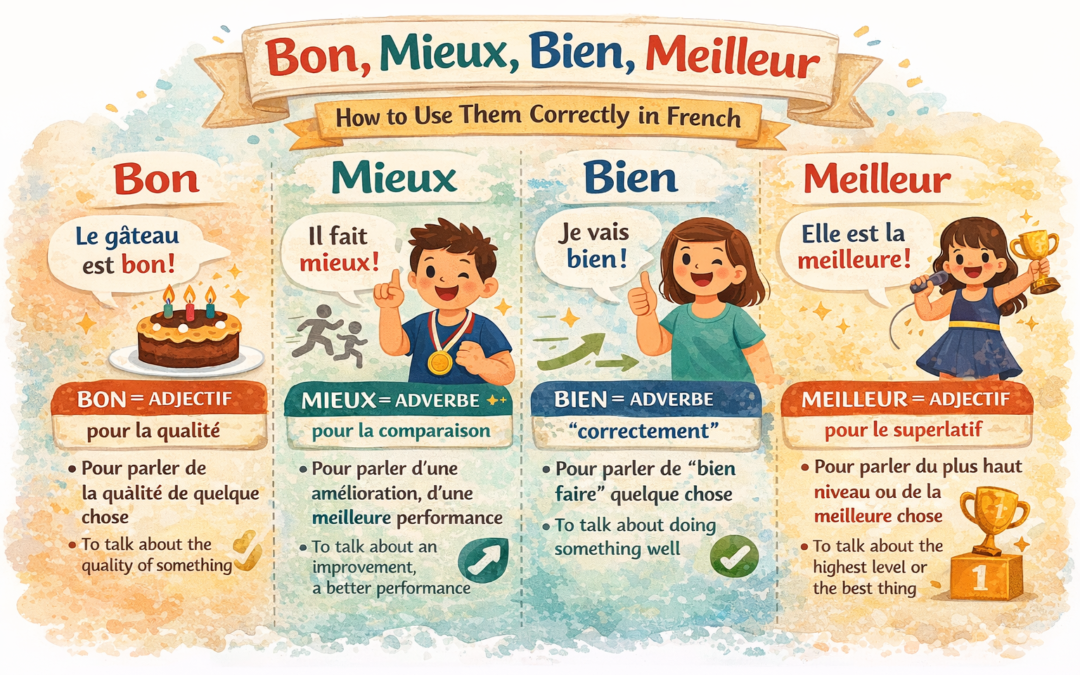
Learning French often means confronting small words that cause big confusion. Among the most challenging for learners are bon, bien, mieux, and meilleur. These words are closely related, frequently used in daily conversation, and yet very easy to mix up — even for intermediate learners.
Why is this so difficult?
Because English often uses “good” and “better” in ways that don’t clearly distinguish between adjectives and adverbs, while French makes this distinction very strictly. In French, choosing the wrong form can make a sentence sound unnatural or simply incorrect.
In this article, we will explore:
- The definitions of bon, bien, mieux, and meilleur
- Their grammatical functions
- How and when to use each one
- Clear, real-life examples
- Common mistakes to avoid
- Exercises with increasing difficulty
By the end of this article, you will confidently know which word to choose — and why.
Definitions: What Do These Words Mean?
Let’s begin with simple definitions.
| French word | Meaning in English | Type |
| bon / bonne | good | adjective |
| bien | well | adverb |
| mieux | better | adverb (comparative of bien) |
| meilleur / meilleure | better / best | adjective (comparative of bon) |
At first glance, this looks straightforward. The real difficulty comes from function, not meaning.
Bon: The Adjective “Good”
Definition
Bon means “good” and is used as an adjective. It describes a noun.
Function
- Modifies a noun
- Must agree in gender and number with the noun it describes
Forms
- Masculine singular: bon
- Feminine singular: bonne
- Masculine plural: bons
- Feminine plural: bonnes
Examples
- C’est un bon restaurant.
(It’s a good restaurant.) - C’est un bon gâteau
(It’s a good cake)
- Elle a une bonne idée.
(She has a good idea.) - Ce sont de bons élèves.
(They are good students.) - J’ai mangé des bonnes pommes.
(I ate good apples.)
Key Rule
If the word describes a thing or a person, use bon.
Bien: The Adverb “Well”
Definition
Bien means “well” and is an adverb.
Function
- Modifies a verb
- Describes how an action is done
- Never agrees in gender or number
Examples
- Elle parle bien français.
(She speaks French well.) - Tu travailles bien.
(You work well.) - Le film commence bien.
(The movie starts well.)
Bien vs Bon (Classic Confusion)
Compare:
- Il est bon. → He is good (as a person or professional)
- Il va bien. → He is doing well
Exception: Bien + Être
Sometimes bien can describe a state, not an action:
- Je suis bien ici. (I feel good / comfortable here.)
Still, bien does NOT describe a noun.
Mieux: “Better” as an Adverb
Definition
Mieux means “better” and is the comparative form of bien.
Function
- Modifies a verb
- Used to compare actions or states
Examples
- Elle parle français mieux que moi.
(She speaks French better than me.) - Tu travailles mieux maintenant.
(You work better now.) - Je me sens mieux aujourd’hui.
(I feel better today.)
Meilleur: “Better” as an Adjective
Definition
Meilleur means “better” or “best” and is the comparative of bon.
Function
- Modifies a noun
- Must agree with the noun
Forms
- Masculine singular: meilleur
- Feminine singular: meilleure
- Masculine plural: meilleurs
- Feminine plural: meilleures
Examples
- C’est le meilleur film de l’année.
(It’s the best movie of the year.) - Elle a une meilleure solution.
(She has a better solution.) - Ce sont mes meilleurs amis.
(They are my best friends.)
Comparison Structure
- Meilleur(e)(s) que:
Elle est meilleure que moi en maths (She is better at math than I am)
Il est meilleur cuisinier que sa femme (He is a better cook than his wife.)
- Le (la) meilleur(e)(s) de:
Ce vin est le meilleur de l’année (This wine is the best of the year.)
Cette fille est la meilleure de l’année en maths
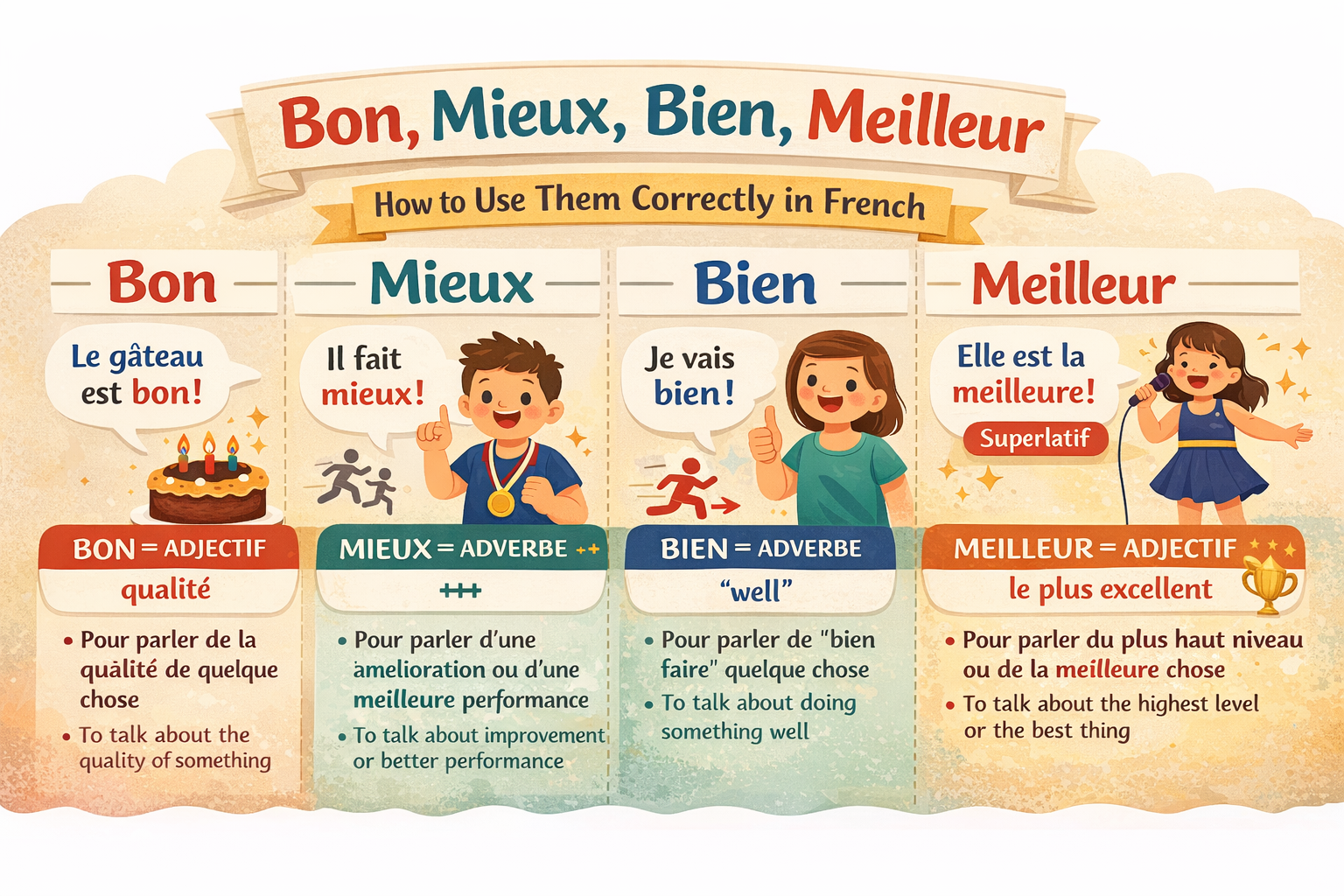
Bon vs Bien vs Mieux vs Meilleur: A Clear Comparison
Let’s summarize with a practical table:
| Situation | Correct word |
| Describing a noun | bon / meilleur |
| Describing an action | bien / mieux |
| Talking about “good” | bon / bien |
| Talking about “better” | meilleur / mieux |
Common Mistakes and How to Avoid Them
Mistake 1
Elle parle français bon.
Correct:
Elle parle français bien.
Reason: “parler” is a verb.
Mistake 2
C’est un mieux restaurant.
Correct:
C’est un meilleur restaurant.
Reason: “restaurant” is a noun.
Mistake 3
Je vais bon.
Correct:
Je vais bien.
Practical Examples in Context
At a Restaurant
- Ce plat est bon. (The dish is good.)
- Le serveur travaille bien. (The waiter works well.)
- Ce restaurant est meilleur que l’autre. (This restaurant is better than the other.)
- On mange mieux ici. (We eat better here.)
At School
- C’est un bon élève. (He is a good student.)
- Elle explique bien la leçon. (She explains well the lesson.)
- Il a une meilleure note. (He has a better mark)
- Tu comprends mieux maintenant. (You understand better now)
Exercises
Exercise 1: Choose the Correct Word
Choose between bon, bien, mieux, meilleur.
- Ce gâteau est très ___.
- Elle chante ___ que moi.
- C’est la ___ solution.
- Tu travailles ___ aujourd’hui.
- Il est un ___ professeur.
Exercise 2: Correct the Mistakes
- Il parle français bon.
- Ce film est mieux que l’autre.
- Elle fait son travail bonne.
Exercise 3: Translation
Translate into French:
- She feels better today.
- This is the best hotel in the city.
- He works well.
Answers
Exercise 1
- bon
- mieux
- meilleure
- mieux
- bon
Exercise 2
- Il parle français bien.
- Ce film est meilleur que l’autre.
- Elle fait son travail bien.
Exercise 3
- Elle se sent mieux aujourd’hui.
- C’est le meilleur hôtel de la ville.
- Il travaille bien.

Conclusion
Understanding bon, bien, mieux, and meilleur is a major milestone in mastering French. These words appear everywhere — in conversations, exams, films, and professional settings. The key is not memorization, but function.
Remember:
- Bon / meilleur describe things
- Bien / mieux describe actions
Once this distinction becomes natural, your French will sound more accurate, more fluent, and more confident.
If you’re teaching French or learning it seriously, revisiting these four words regularly is one of the best investments you can make.