
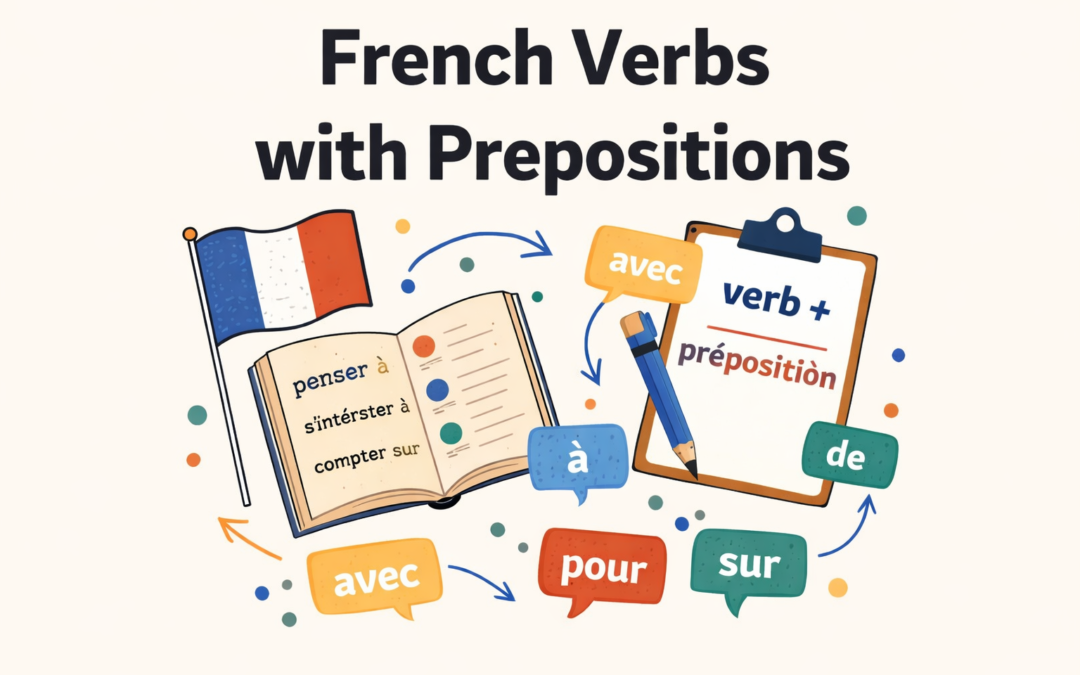
If you read the first article titled “À or De in French: How to Choose?”, you learned a key principle for improving in French:
The preposition depends on the word that comes before it, often a verb, an adjective, or a fixed expression.
That first article helped you understand the general logic, with simple rules to know when to use à and when to use de, along with examples to help you memorize them more easily.
However, as you continue learning French, you quickly notice that some structures become fixed patterns, especially verbs that always require the same preposition. For example:
| Verb + preposition | Sentence in French | English Translation |
| penser à | Je pense à mes vacances. | I’m thinking about my vacation. |
| rêver de | Je rêve de voyager en France. | I dream of traveling to France. |
| essayer de | J’essaie de parler français tous les jours. | I try to speak French every day. |
And this is exactly what leads us to this second article:
In this new article, we go further. We’re no longer just choosing between à and de we’re learning to memorize the essential verb–preposition combinations to sound more natural when speaking.
Verb + Preposition + Object or Infinitive?
Some French verbs require a preposition before a noun, pronoun, or infinitive. This preposition can be à, de, or sometimes none at all.
| Verb | Structure | Example in French | English Translation | ||
| penser | penser à + noun | Je pense à toi. | I’m thinking about you. | ||
| rêver | rêver de + noun | Elle rêve de succès. | She dreams of success. | ||
| réussir | réussir à + infinitive | Nous réussissons à parler français. | We manage to speak French. | ||
| oublier | oublier de + infinitive | Il oublie de répondre. | He forgets to answer. | ||
| vouloir | no preposition | Je veux apprendre le français. | I want to learn French. | ||
The challenge is that you cannot change the preposition.
It is not optional and not a matter of style it is fixed to the verb.
Verbs That Use “à”
We use à with some verbs when followed by:
- a noun
- a pronoun
- an infinitive verb
| Verb | Example in French | Translation | |
| penser à | Je pense à mes projets. | I am thinking about my plans. | |
| réussir à | Elle réussit à conduire. | She manages to drive. | |
| apprendre à | J’apprends à danser. | I’m learning to dance. | |
| aider à | Il m’aide à faire mes devoirs. | He helps me do my homework. | |
| commencer à | Nous commençons à comprendre. | We are starting to understand. | |
| continuer à | Elle continue à chanter. | She continues to sing. | |
💡 Memory Tip:
à = movement, effort, direction toward a goal.
You go toward something → à
Verbs That Use “de”
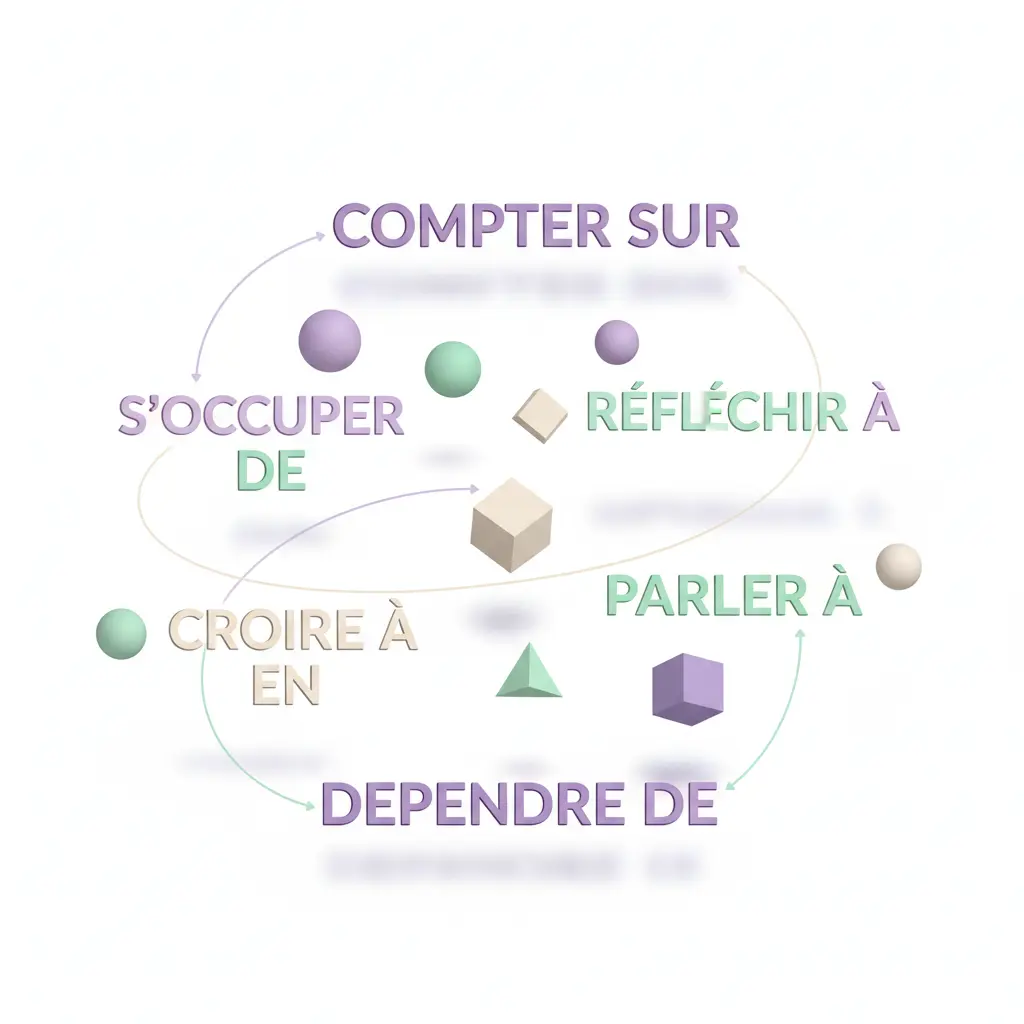
Some verbs require de, especially when they express:
- a desire or wish
- emotion or inner thought
- obligation or choice
| Verb | Example in French | English Translation |
| rêver de | Je rêve de vacances. | I dream of a vacation. |
| oublier de | Il oublie de fermer la porte. | He forgets to close the door. |
| essayer de | Elle essaie de comprendre. | She tries to understand. |
| arrêter de | Nous arrêtons de fumer. | We stop smoking. |
| parler de | On parle de lui. | We are talking about him. |
| avoir besoin de | J’ai besoin de dormir. | I need to sleep. |
💡 Memory Tip:
de = inner feeling, emotion, personal intention.
Verbs With No Preposition
Some verbs are followed directly by an infinitive — no preposition needed.
These are often modal verbs or high-frequency verbs.
| Verb | Example in French | Translation |
| vouloir | Je veux parler français. | I want to speak French. |
| aimer | Nous aimons voyager. | We like traveling. |
| préférer | Elle préfère rester ici. | She prefers to stay here. |
| espérer | Ils espèrent gagner. | They hope to win. |
| devoir | Je dois partir. | I must leave. |
| pouvoir | On peut continuer. | We can continue. |
How to Memorize These Structures?
There is no universal logic, but these strategies help:
Learn by category
- Verbs expressing feelings → often de
- Verbs expressing movement or goal → often à
Personalize your sentences
❌ Neutral sentence: Il réussit à finir. (He manages to finish.)
- Useful sentence: Je réussis à parler français avec confiance. (I manage to speak French confidently.)
Listen and read real French
Exposure makes patterns automatic.
Repeat often, just 5 minutes a day works.
Useful Lists to Memorize
Verbs That Use à
- aider à
- apprendre à
- commencer à
- continuer à
- hésiter à
- inviter à
- réussir à
- penser à
Verbs That Use de
- arrêter de
- essayer de
- éviter de
- rêver de
- décider de
- promettre de
- parler de
- avoir envie de / besoin de
Verbs with No Preposition
- vouloir
- aimer
- préférer
- espérer
- devoir
- pouvoir
- savoir
Comparison Table
| Incorrect ❌ | Correct ✔ | Reason |
| J’essaie à parler. | J’essaie de parler. | essayer → de |
| Je pense de toi. | Je pense à toi. | penser → à |
| Nous rêvons à succès. | Nous rêvons de succès. | rêver → de |
| Elle continue de travailler. (also correct with à) | Elle continue à travailler. | Some verbs allow both |
Mini Quiz (Answers Below)
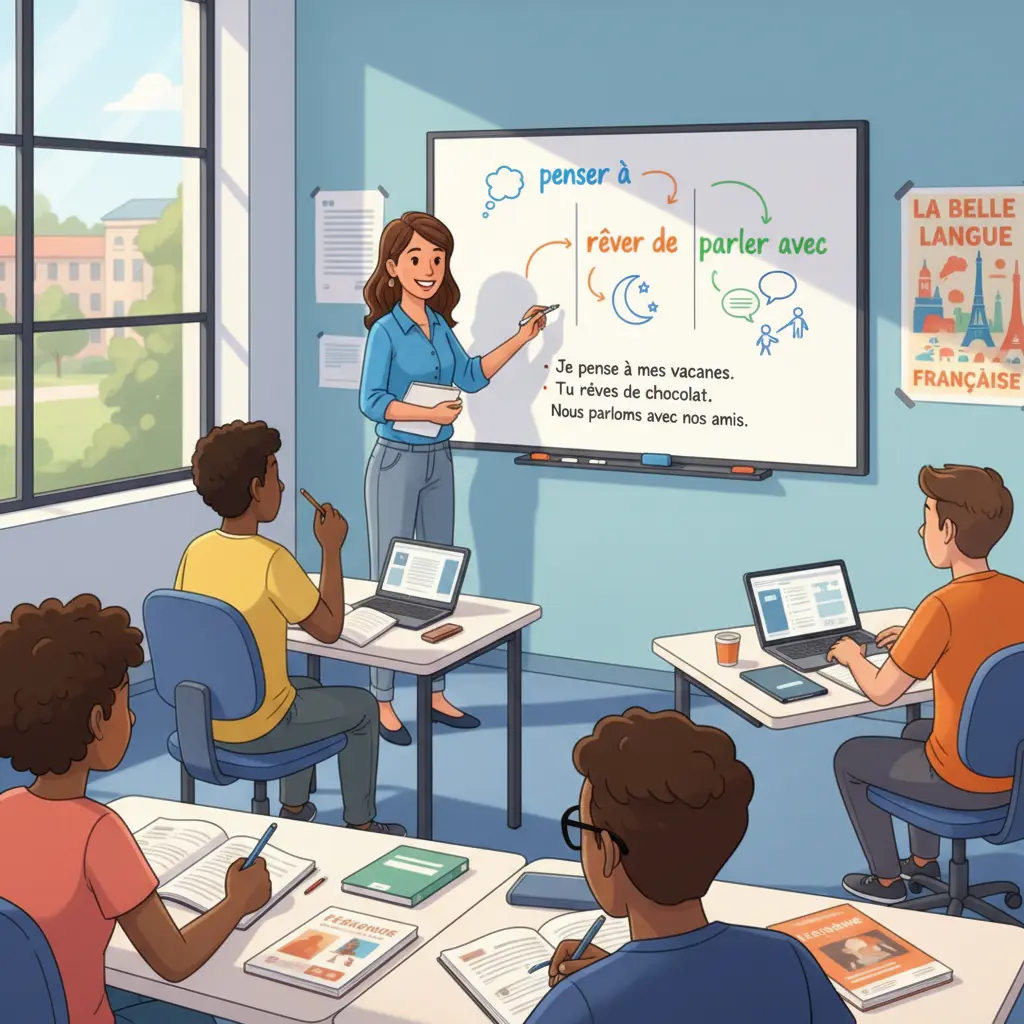
Fill in with à, de, or nothing:
- Je veux ___ apprendre plus vite.
- Ils réussissent ___ comprendre.
- Elle rêve ___ vivre à Paris.
- Tu dois ___ étudier.
- Nous commençons ___ nous sentir à l’aise.
- J’essaie ___ pratiquer chaque jour.
Answers:
- — ; 2. à ; 3. de ; 4. — ; 5. à ; 6. de
Final Encouragement: dare
French verbs followed by prepositions are a normal challenge when learning the language but with practice and repetition, you will memorize them. The goal is not to be perfect immediately, but to use them boldly and often.
Step by step, your brain will begin to recognize patterns naturally.
Keep reading, listening, practicing… and most importantly:
Don’t give up.
Julie